
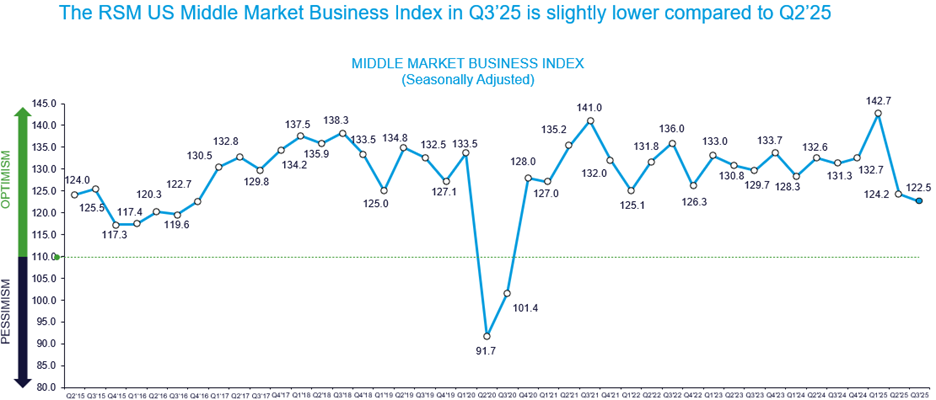
Business sentiment in the U.S. middle market softened in the third quarter of 2025, as executives grapple with persistent inflation and tightening profit margins. The RSM US Middle Market Business Index (MMBI), a joint effort from RSM US LLP and the U.S. Chamber of Commerce, fell to 122.5 from 124.2 in the previous quarter, reflecting a cautious outlook shaped by economic and policy headwinds.
The central issue for many firms is significant margin compression. According to the survey, which polled 404 middle market executives, 67% reported paying more for goods and services. However, only 48% were able to increase the prices they charge their customers, a drop from 56% in the second quarter. This gap suggests companies are absorbing more of the rising costs, directly impacting profitability.
“Margin compression is the defining theme of this quarter’s survey results,” said Joe Brusuelas, chief economist with RSM US LLP. “Input costs are rising faster than prices received, and profitability will stay under pressure until companies can pass more of these costs on to customers.”
Current business performance reflects this pressure, with only 37% of executives reporting economic improvement in the third quarter. Similarly, 39% saw revenue growth and 43% noted higher earnings.
Despite the current challenges, there is a degree of optimism for the near future. Half of the business leaders surveyed expect the economy to improve over the next six months, with 58% anticipating revenue gains and 60% projecting stronger earnings, largely in anticipation of pro-growth fiscal policies and tax cuts slated for 2026.
External factors, particularly tariffs, are complicating business operations. The survey indicates that tariff schedules are creating uncertainty around inventory management, causing firms to slow down accumulation. Only 35% of respondents increased inventory in the third quarter, though 44% plan to do so in the coming six months.
"It is clear that the benefits from the recent enactment of the tax bill – greater certainty and reduction in the after-tax costs of capital investments – are being eroded by tariffs and greater than usual policy and economic uncertainty," said Neil Bradley, executive vice president and chief policy officer at the U.S. Chamber of Commerce.
This cautious sentiment has also translated into a slowdown in hiring and capital expenditures. In the third quarter, 34% of firms increased hiring, and 38% boosted capital outlays. Looking ahead, plans are slightly more robust, with 46% of executives expecting to increase hiring and 50% planning to boost investment in the next six months.
The RSM US Middle Market Business Index (MMBI) can be downloaded here.
SOURCE: RSM US LLP
© Arc, All Rights Reserved. Request academic re-use from www.copyright.com. All other uses, submit a request to TMSalesOperations@arc-network.com. For more information visit Asset & Logo Licensing.