So when it comes to life on the road, consultants are reporting slightly more trips for the first time in a few years. What's it all mean?
The last few years of the Best Places to Stay survey saw pretty significant pullback on travel from previous years, with consultants' trips shorter than they had previously been and clients growing more and more cost-conscious about those trips. This year's results put an end to that trend, with consultants hitting the road again. With the economy continuing to chug along and consulting pipelines strong, travel is trending up—despite talk of an economic slowdown on the horizon.
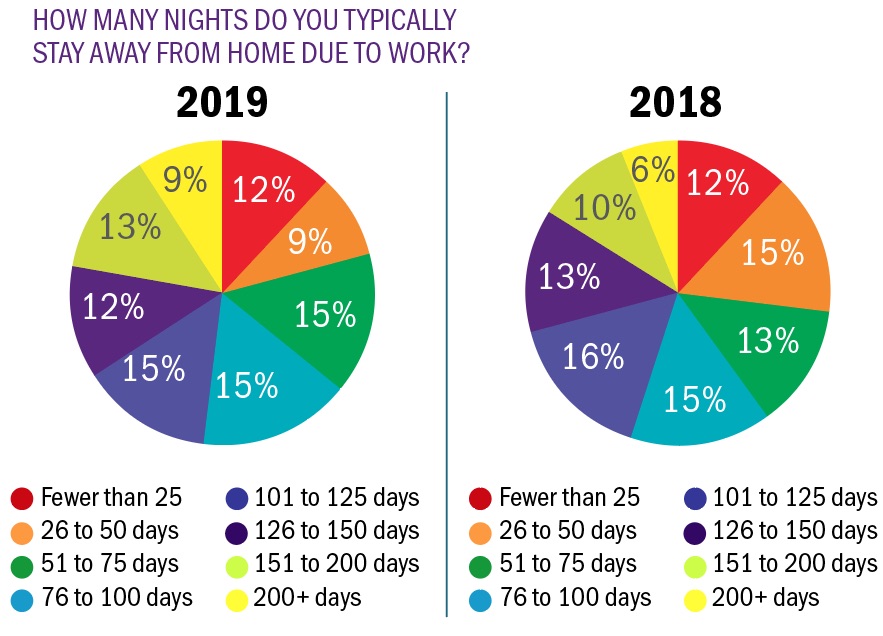
In 2016, 51 percent of consultants reported they spent more than 100 days a year on the road, but that number dipped to 46 percent in 2017. It was more of the same last year as that number is now 45 percent, which the lowest it's been since the Great Recession a decade ago. But this year's results reverse that trend as 49 percent of consultants spent more than 100 days a year on the road. And consider this: Road warriors who spend more than 150 days on the road was back to 2017 levels—22 percent—after dipping all the way to 16 percent last year.
For the purposes of measuring consultants' travel, the 150-day threshold works out to about three or more days per week, which is considered to be the benchmark for achieving "road warrior" status in the profession. There was a pretty significant decrease in the number of consultants traveling between 26 and 50-days, which is about a day a week. This year, it measured just 9 percent, down 6 percentage points from last year.
This year, 185 consultants participated in Consulting's annual Best Places to Stay survey, reporting their travel habits and preferences for the last 12 months. The survey was conducted between April and July.
Days away up 2%
Meanwhile, the average number of days away this year was 96—a 2 percent increase year on year from 94 last year. Although that number ticked up, it is still pretty significantly off from just a few years ago. In 2015, the number was 120 days. In those four years, the overall number of days dropped 20 percent. While the economy is still relatively strong, there may be a bit of correction coming as consultant travel is often one of the first indicators of any changes in the economy. Technology is also likely playing a role.
When it comes to clients wanting to control travel costs, it's a bit of mixed bag. In 2019, there was no real change in clients requesting less travel than last year—5 percent this year vs. 6 percent last year. And more clients were requiring lower travel costs at 10 percent vs. 7 percent.
When we asked consultants to tell us about clients negotiating travel expense limits—number that has been declining for years—we saw a 1 percent increase from 21 percent to 22 percent.
Some 88 percent of consultants report booking their own travel reservations, while 8 percent still say their firm's corporate travel agency is handling it. The remaining 4 percent say their client's travel department is handling their accommodations.

A Room With a View
Consultants still spend plenty of days in hotel rooms, so it's no surprise at all that they continue to choose top-notch accommodations to help make their time away from home a little more pleasant. When we asked consultants where they'd prefer to stay, The Ritz-Carlton came out on top with the St. Regis, The Four Seasons, the JW Marriott and W Hotels rounding out the top five.
But what drives consultants' hotel choices? Location rules the day followed by the Quality of the Accommodation followed by Loyalty Programs and Price.
Speaking of those hotel loyalty programs, Marriott takes the top spot with Hilton edging out Starwood for the second spot. Those results were unchanged from last year's survey. And when it comes to Wi-Fi, no one wants to pay for it anymore with a whopping 98 percent expecting Wi-Fi to be free. Typically, it is—especially for a brand's loyalty club members.
Eight Miles High
The vast majority of the trips consultants take begin and end on a runway. And let's face it: There's no shortage of bad flights, bad press, bad food and bad behavior—and consultants shared plenty in the open-ended questions on the survey.
So, when it comes to air travel, which carriers do the best job? Which do consultants prefer? Well, for starters, it would be helpful if a consultant had some steady clients in Singapore, as Singapore Airlines finished first among consultants. Lufthansa, Virgin Atlantic, Alaska Air and Virgin America round out the Top 5.

And in terms of choosing that airline, Price is—far and away—the top consideration for consultants with 57 percent saying it is the top priority. Corporate travel policy is a pretty distant second, followed by change fees. Baggage fees and fuel surcharges, which seem to keep being added but never taken away, round out the Top 5, although the bottom two barely even register at a combined 3 percent.
Car & Driver
While an automobile isn't always necessary, they are often a big part of the travel experience. This year, National repeats in the No. 1 the spot while Hertz, Avis, Enterprise and Budget round out the Top 5.
And when it comes to choosing the right car, Price is the biggest indictor at 35 percent, while Ease of Check-In, Check-Out coming in a close second at 27 percent. This year, Car Availability and Corporate Travel Policy finish third and fourth in terms of importance, while those pesky fuel surcharges keep coming last.

© Arc, All Rights Reserved. Request academic re-use from www.copyright.com. All other uses, submit a request to TMSalesOperations@arc-network.com. For more information visit Asset & Logo Licensing.