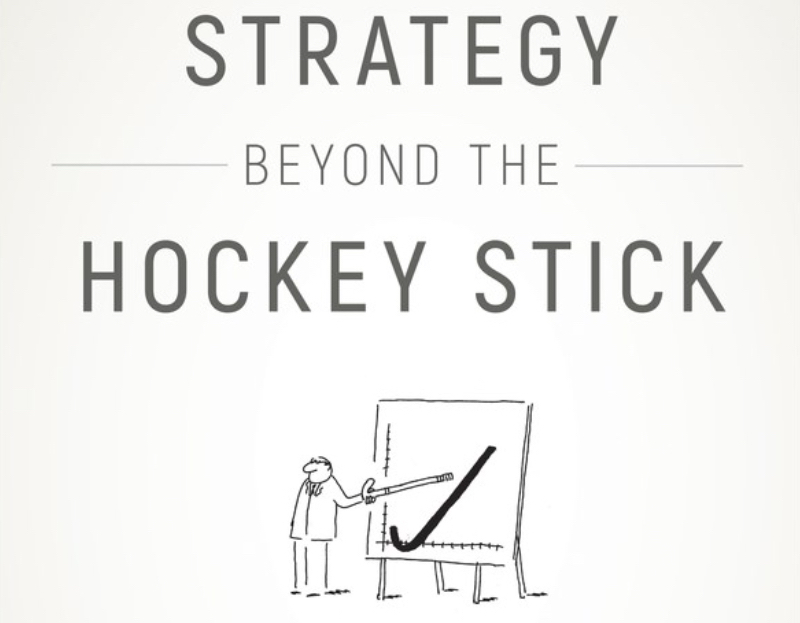
 In their new book, Strategy Beyond the Hockey Stick: People, Probabilities, and Big Moves to Beat the Odds, McKinsey & Company strategy leaders Chris Bradley, Martin Hirt and Sven Smit address how companies can conquer the human side of the strategy room, so that bold moves and real growth can happen. The authors studied the performance of over 2,400 of the world's largest companies over a ten-year period to find out what factors in a corporate strategy move the needle on performance, including: How human behaviors in the strategy room can foil even the smartest strategies; How companies can calibrate and shift the odds of success for a strategy; and, Why strategy success depends on a steady drumbeat of big moves. Anyone in the strategy room will be equipped to change the way they evaluate strategies to result in the best possible outcomes. Consulting caught up with Bradley and Smit to discuss the social side of strategy, big moves and how to tilt the odds for exceptional performance into your favor.

Consulting: Congratulations on the book. So, talk to me a little bit about the origins of the book. What do you hope the book brings to the conversations around strategy? In short, why this book now?
Bradley: The book was basically the collision of two worlds—the first was big data, probability, the power curve, which we'll go into later, and really what actually drives corporate success. But then what we did was bring it into another world, which was the lived experience of executives actually trying to get strategy done. Our book was kind of born where those two worlds are crashing into each other. Instead of providing framework and case studies, we spent five years doing empirical research on the world's largest 2,400 companies, covering 127 industry sectors and 62 countries, and their performance over a ten-year period. We wanted to find out what really impacts long-term performance. What we found are 10 levers that are the strongest determinants of your odds of success out of 40 variables we examined.

Consulting: So, how does the influx of all this data impact the discussion around strategy? That's the game changer, right?
Smit: In most companies, strategy is sort of an annual process. Leaders aim to keep it short and brief and issue focused. But that process is not very conducive to planning strategy, it's more conducive to setting a budget or a financial plan. The frustration with the strategy process is very high. If all strategy plans were certain, you would just approve them and move on. But there are far more agendas in the strategy room than just developing a strategy: budgets are being negotiated, resources are being protected, and jobs and promotions are on the line. The process is clouded by self-interest, internal policies and biases. We call this the social side of strategy. It's that tension between the conversation that's happening and the data that might be, in our mind, the solution to changing the dynamics in the strategy room.
Consulting: So, what can companies—or what should companies—do to move the needle?
Smit: We write in the book that we're not introducing a new framework. Many strategy concepts were frameworks; we're not doing that. Our book talks about, and others have talked about, the biases in our brains. If you confront the biases in our brains and our decision making with the data, you can see why the data suggests when all those biases are at play. We discovered, for instance, that a lot of people come into the strategy room for really one purpose—a resource ask. They want to ask for resources and they want to get to a 'yes.' They have a confirmation bias; they basically play the game to get to a 'yes'. What we find is the probability of achieving all that's promised is, in reality, much less than what is being presented to get that the answer they're seeking.
Bradley: I think there's two sides coming of age here: The social science has moved a long way forward and the empirical science has moved a long way and we're just putting them together. Instead of benchmarking a strategy with the "inside view" based on internal data—past performance, projections for the next year, and what their closest competitors are doing, companies can use an approach we arrived at to calibrate the odds of their strategies succeeding, so they have real benchmarks for making strategic choices.
Consulting: Are these the types of insights you're currently working on with clients on when it comes to strategy discussions?
Bradley: If you look at what McKinsey has published over the last decade, we've really been ahead of the curve in terms of introducing bias and behavioral economics into the world of strategy. Rather than set our work in the abstract world of white boards and lecture halls, we set it in the real world of the strategy room and experience that comes from working with hundreds of clients. We discovered clients can shift the odds by capitalizing on their endowment, riding the right trends, and most importantly, making a few big moves. Your endowment is what your company starts with, and trends are like the winds at your back. But the biggest impact comes from keeping up a steady drumbeat of big moves—things like M&A deals, or the productivity improvements that are significantly greater than those of your competitors. If your strategy doesn't involve several of these, the odds are stacked against you.
Consulting: How much does this particular approach improve the outcomes?
Smit: All the work that we've shown and the data say the people that succeed make bigger moves than their competition. That sounds very easy but strategy and framework is never benchmarked that way. Making one or two big moves more than doubles your strategy's odds of success, from 8 percent to 17 percent. Three big moves boost the odds to 47 percent. Companies that made three or more big moves were six times more likely to jump from the middle quintile to the top. You take a move like resource re-allocation and the average firm re-allocates about 2 percent a year. But a big mover will re-allocate 5 or even 6 percent a year. Over ten years, one company will be 20 percent new and the other will be more than 50 percent new. It sounds very simple, but the data suggests that companies that don't get to the 5 percent are not really getting the effect of resource allocation because they are just doing the average—what everyone is doing. Even though the data would indicate that it should, the reality is that these big moves usually don't enter the C-level conversations the way they should.
Bradley: Let's put that together… we know resource re-allocation should be 5 or 6 percent and most companies do 2 percent so we need to find a way to triple a company's resource re-allocation. So, why is that so hard to make happen? Well, that's where we start to get into the human factors… in order to do this, someone has to lose. The executives believe us on the data; they know we've done our homework but it's often tough to convince them to take the necessary steps.
Consulting: You talk quite a bit about The Power Curve in the book. Can you explain it?
Bradley: The Power Curve says that when you look at a snapshot of time, the middle 60 percent of companies are earning their cost of capital. That's actually not a bad thing; those companies generally earn shareholder return, pay investors back and can make incremental improvements. So, let's not begrudge that everyday hard work that the middle 60 percent do. It's just that the Top 20 percent are so remarkably different than the middle 60. An 8 percent chance to participate in that top quintile is extremely valuable. And when we look at the data, 78 percent of them stay in the middle, but over a ten-year period, about one in 12—or about 8 percent—jump from the middle to the top. The question is why do some make the jump and others don't? That's where our research led; what gives a company better odds vs. a company that had really poor odds. When we talk to CEOs, they're often surprised by how hard it is to make a move on the Power Curve—that 8 percent statistic really resonates. They're also surprised by the fact that companies in the top quintile capture nearly 90 percent of the economic profit created—some 30 times as much as those in the middle three quintiles.
Consulting: It doesn't sound like there's a shortage of ideas or initiative—you talk about that specifically in the chapter about choosing the right hockey stick—but which ones to pursue seems like the toughest decision. Is that why more companies don't make the big moves or take the big risks?
Bradley: There are lots of ideas; everyone has a plan and everyone has a hockey stick idea, but having something in a to-do list is not the same as a big move. And that's the power of these calibrations, the power of the strategy benchmarking. Let's go back to the one we've already talked about, resource re-allocation. Everyone is talking about how they are pursuing new growth businesses but if you're not moving 6 percent of your budget to new places, you're not making a big move.
Smit: One proof point of whether a big move is being made is if the company is taking the first step, which is what we suggest. One insurance company made a long-range plan that there will be paperless in the future, which is logical. But then the CEO looked into the paper forecast for the following year and it was up 5 percent! The CEO decided to set paper growth at zero the next year and start to decrease it the year after. He started the process to a paperless environment. You could have the best long-range plan but it's up to the leaders to force the first step. If I set a goal that 50 percent of our business was going to be in emerging markets, but next year we're only budgeted for 1 percent, we'll never get that goal. Often big moves are about the first step, which can be difficult.
Consulting: What are some other pitfalls to making big moves happen?
Smit: We see that many companies don't have the resources freed up ahead of making a big move. So we would suggest that you should separate the improvement process from the resources. Typically, the current processes are not set up that way that the money will be available when you make a decision.
Bradley: If I could back track for just a second: your previous questions asked why more companies weren't taking big risks. We're saying companies need to take less risks and they can do that by being bolder. Let me connect those two things: The illusion is that timid plans are safe but the world is very violent and competition is very severe and intense. The status quo is actually the least likely outcome over a ten-year period. On the Power Curve, industries are just as likely to move up and down as companies are; the world is not static. The really interesting thing we found is that it's not about being reckless; it's actually the safest best to make the big move. Making big moves almost uniformly increases your exposure to upside and reduces your exposure to downside. Now remember we're talking about a ten-year period. Moving more than 6 percent of your resources in any given year could be perceived as reckless, so there's a lot to be said about the companies that go up the Power Curve doing it over an extended period of time to actually put something together very special. Big moves are not a one-time deal. That would be risky and reckless.
Consulting: Ultimately, what do you hope the book achieves?
Bradley: Our big mission is to help our clients unlock the big moves they should make. It's not coming in with a theory but coming in with a very helpful solution addressing the social side of strategy. It's also about calibrating and well-formulated big moves. We've got good science and good engineering and we actually know what it takes to shift the odds.
Smit: The real ambition, I think, is that the strategic discussions happening in board rooms will be different as a result of this book.
© Arc, All Rights Reserved. Request academic re-use from www.copyright.com. All other uses, submit a request to TMSalesOperations@arc-network.com. For more information visit Asset & Logo Licensing.