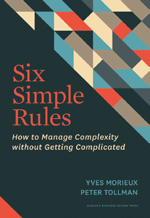
 BCG's Six Simple Rules sets out to simplify some organizational complexity
Does your organization manage complexity by making things more complicated? According to the Boston Consulting Group's Complexity Index, business complexity has increased sixfold during the past 60 years. And organizational complicatedness—the number of structures, processes, committees, decision-making forums and systems—has increased by a factor or 35. What's going on? Clearly, it's time for leaders to stop trying to manage complexity with traditional tools and instead better leverage their employees' intelligence, according to BCG's Yves Morieux, Senior Partner and Director of the BCG Institute for Organization. Morieux, one of the authors of Six Simple Rules: How to Manage Complexity Without Getting Complicated (along with BCG's Peter Tollman), argues the solution lies in a handful of rules designed to reinvigorate people in the face of seemingly endless organizational complexities. Morieux sat down recently with Consulting to discuss the book, the rules and the outlook for organizations that conquer the complexities to create competitive advantage.
Consulting: Can you give me a sense of where the idea and inspiration for the book developed?
Morieux: That's a very good question. On the one hand, most of our time at BCG is spent working with clients to help them improve their performance—productivity, speed to market, return on investment, working capital—all of these types of things. And, to do this work, we spend a lot of time observing, analyzing, measuring, interviewing people, using specific methodologies. As we were working on these performance improvement issues, well, sometimes the people we were talking to started to cry. [Laughs] You have a 50-year old regional manager… and this is just an interview, not for hiring, not for firing, but for information gathering. You know, tell me about your job, tell me with whom you have to interact to do your job, with whom you have to collaborate etc., and people started crying during the interview. And, of course, we talked to HR and we said 'do you know if this lady or this gentleman has a health problem, is depressed, has had a nervous breakdown?' And HR said: 'no, I don't see why you're asking me these questions, there is no problem whatsoever with that person.' And there seemed to be more and more clear signs of suffering at work. This was, I would say, the real starting point of the book.
Consulting: So, this is one of the questions you set out to ask? Why are people suffering?
Morieux: Well, we wanted to know why there is so much suffering at work, despite all the efforts made by HR and others to make employees feel better. You know, the people initiatives, the celebrations, the team rallying sessions, so this was the real starting point, trying to understand why people are suffering, as well as why productivity is so disappointing. So it is a real enigma. And this is when we discovered that the real root cause of both a lack of productivity and suffering is due to what we call 'complicatedness,' you know the labyrinth in an organization where people lose meaning, direction and purpose.
Consulting: And what did you find? Did you find that people were just feeling completely overwhelmed with what needed to be done and their methodology for getting it done?
Was that the root of suffering?
Morieux: The crux of the suffering is that people receive contradictory instructions from the top of an organization, to put it in a nutshell. The business environment has become more complex, and you know complexity means contradictory requirements. This is what we call 'business complexity' and there is nothing wrong with that. The problem is that the organization for structures, processes and instructions, has translated this business complexity into contradictory orders, contradictory instructions, contradictory matrices and contradictory structures. This is where people lose direction. This is where they lose purpose. This is where they get lost and they disengage. And because it's so difficult and hard, companies add the 'soft' to counter it—they bring in the psychologists, the stress therapists, they launch all those people initiatives to engage people. This only handles the symptoms, not the root causes, so eventually we put the guilt on people. We say to the people, 'look, it's your fault. There must be something wrong with you. We engage you, we create people initiatives and you are not able to get engaged, there must be something wrong with you.' So, there's this double guilt.
Consulting: So, you and Peter recognized these complexity issues… how does this end up as a book?
Morieux: In social sciences, enormous progress has been made over the last few years that hasn't really made its way down to consultants and business leaders. And, my background is micro-economics, game theory, organization sociology, so with a team I started to implement that at different clients. And at the beginning it was a bit blunt, a bit half-baked difficult to digest by our clients, notably what we call sociological analysis. It's something very demanding, you have to do a lot of interviews that last 90 minutes, and this is why, by the way, people started to cry because suddenly they talk about the real things, the authentic things, and they don't hide anymore. They speak the truth and the truth is so hopeful for them that they start to cry. Now, with Peter we have made these tools digestible, easy to use, easy to implement, practical for clients. So, together we have made the state of the art of social sciences. We have brought it to managers' and business leaders' fingertips. This is our contribution. I have worked a lot on the research, the theory, started to implement, and with Peter we have used them together, made them more practical and easier to implement. I would say what BCG has done is we have taken the state of the art and we have made it actionable by managers.
Consulting: And you boiled that all down to Six Simple Rules?
Morieux: What is very important for the simple rules is that they are the system. What is so powerful is that they combine autonomy and cooperation. This is the most difficult thing for companies to grasp; they are not able to combine autonomy and cooperation in the workplace. So, the first three rules concentrate on autonomy. How do I use the group to enable each individual to have more autonomy? The last three rules are about making sure that people put their autonomy in the service of the group to foster cooperation. So, the six rules are complementary, the first three advantaging people's autonomy, and the last three rules are about making sure that everyone's autonomy is put in the service of the group to face complexity.
Consulting: Can you highlight a few of the key rules?
Morieux: I would say that each of them are equally important, but if I was to select two of them to highlight here, I would say the first one—understand what your people do, and why they do what they do—is pretty important. It's actually the most important because it's the one that people forget about the most. Usually, we don't really know what people do. When BCG works with some companies, we hear 'we know what people do; let's not waste time with Rule #1. We already know the problem—let me summarize what is basically our sales people are not cross selling; our managers are not deciding, and when they do decide, they don't implement their decisions properly.' And that's not what their people do; that's what they don't do. People don't spend their day not doing, people don't say: 'this morning I will start with two hours of not cross selling, then two hours of not deciding and then, in the afternoon, if I have some energy left, I will spend four hours not implementing what I did not decide in the morning.' People do things. And too often, we concentrate on what they don't do. We don't look at what they do do. And, because we don't look at what they really do, we don't understand why they do it, therefore we cannot change why they do what they do. It's incredibly important, that's why we make it Rule #1.
Consulting: And the second?
Morieux: The second most important would be Rule #2—reinforce integrators. When there is a problem between the back of this, and the front of this, we tend to create the middle of this. So, instead of one problem between the back and the front, now we have two problems between the back and the middle and between the middle and the front, plus we have to pay for the middle of this. An integrator is not the middle of this. It's not an interface, it's not a coordinator. It is a manager; a line manager to whom you give power and interest to make others cooperate. And as soon as you reinforce integrators, you can eliminate a lot of complicatedness in matrix organizations. If you look at organizations, many of them are complicated matrix structures because we have failed to reinforce managers as integrators, so we just add new dotted lines, new functional lines, new full lines instead of reinforcing managers. So, perhaps not coincidentally, Rule #1 and Rule #2 are the two most important, I would say.
Consulting: Where did we go wrong with all of this?
Morieux: To put it simply, we have outgrown our tool kits. Organizations, globalization and competition have grown faster than the management tool kits, many of which are still based on ideas and principles from the beginning of the 20th century. During the Industrial Revolution, you didn't need to cooperate because there was very little complexity. Companies, business schools and consultants have not yet leveraged all the new discoveries in social sciences in recent years, what I call 'organizational sociology,' and there's still a lot to learn.
Consulting: If the entire company buys in, great. But what if I'm a manager and I'm sort of stuck in an organization that doesn't quite get it from the top down? Are there ways that I can make my own department less complex?
Morieux: That is a great question. Why? Because, on the one hand, I would say the CEO is the best person to implement what we at BCG call 'Smart Simplicity'. And, in most cases when we have worked with companies on implementing the simple rules, it's being led by the CEO. So, the best place to start is with the CEO.
However, if you are the head of the department, if you are a team leader, there are many things that you can start doing around the simple rules, notably, simple Rule #1. You have a huge opportunity and perhaps the CEO has more room to maneuver, but at every level in the organization people can use their judgment to use simple Rule #1, then to make propositions based on the other rules to be discussed. And this is what we propose. We propose a tool for healthy, factual management conversations based on performance issues.
Consulting: What do you see as the major takeaway in this book?
Morieux: What I would like to happen is that people feel reassured, we are not bound to suffer more because we have in the past. There are solutions, and these solutions depend on our intelligence and energy. There is no fatality. There is no tragedy. We can act and we can reverse this trend. So, takeaway number one is hope. Takeaway number two is results. This is not an act of faith. This is a methodological approach, there are steps—battle-tested steps—and they work. And you can start implementing them right away.
© Arc, All Rights Reserved. Request academic re-use from www.copyright.com. All other uses, submit a request to TMSalesOperations@arc-network.com. For more information visit Asset & Logo Licensing.