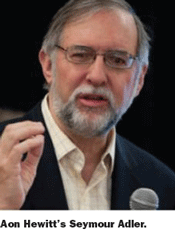
 Aon Hewitt's Organizational Pyschologist Talks Talent Challenges… and Solutions
The beating heart of any organization is its talent, and today's talent pool is in a time of transition. A new generation of young consultants is joining up and finding themselves in decision-making positions, and more seasoned veterans are thinking of bowing out now that their retirement accounts have climbed back from their Great Recession lows. In this new highly generationally diverse workplace, someone has to ensure that the needs of workers of varying ages are met, that the right people are being hired for the right positions, and that top talent is retained. That's where the science of Organizational Psychology comes in. Seymour Adler, Aon Hewitt's Organizational Psychologist, shared some of his insights from the front lines of this new talent challenge with Consulting magazine.
Consulting: What do organizational psychologists look for within an organization?
Adler: Organizational psychologists are very interested in the behavior of people in organizational environments, most typically work environments. They are people who uniquely can apply the full spectrum of psychological science and practice to the workplace. I am interested in social influence and leadership and how people operate in groups and teams. I'm interested in how people formulate attitudes and the influence of those attitudes on how they act. I'm interested in personality and how personality changes over time and how it influences how people behave. And organizational psychologists are folks who can draw from the whole field of psychological science and make workplaces better places to work for the employees and more effective places to work for the organizations.
Consulting: What do you think are the biggest issues right now?
Adler: There's a real focus on attracting retaining and developing high-potential talent. As the economy gets better, organizations are concerned with holding onto their top talent and preparing them for challenges in the future. There may be a large gap in organizations at the top as Baby Boomers who have been slow to retire look around and see their pension funds and 401(k)s in better shape than they were four years ago. So there's a tremendous need for that kind of talent. My clients are large, global companies. Their concern, what's keeping them up at night, is the ability to manage globally in different environments across different cultures. A final talent challenge has to do with diversity. Not in the race or gender sense, though those remain important issues, but maybe most novel is the need to operate in a highly multi-generational organization. There has never been this many generations operating at the same time working in the same organizations and even on the same teams. It's a unique time.
Consulting: What do you see as the biggest challenge of managing all those generations of workers?
Adler: Many of us very often project. It's a basic psychological characteristic. In the absence of better information we assume that other people are motivated by what we're motivated by and see things the way we see them. That's dangerous—especially if you're a Boomer manager managing a Millennial. That Millennial may be motivated by very different things and have very different styles in engaging and working.
Consulting: That's interesting. What are some of the ways you can identify or mitigate people risk?
 Adler: Helping organizations identify the source of the people risk and how to mitigate those risks is a core area I work in. People risks come in all sorts of ways. They come from a lack of succession plan. You have absolutely critical positions, and if that person is hit by a bus or suddenly wins the lottery, abruptly retires or is coaxed away by a competitor, what would you do to fill that gap? I'm directly involved in helping companies do systematic talent reviews and create succession plans so you mitigate people risk. We have research that shows in those critical senior positions if people leave abruptly and there is no clear successor that's been prepared to step into that person's shoes, there's a real impact on the performance of that organization even on its market capitalization for publicly traded companies. It scares customers, it scares supply chain partners, and it scares people inside the organization. It's a real concern.
Consulting: Are you seeing companies more frequently seeking the advice of organizational psychologists?
Adler: In human resources right now one of the hot trends is this notion of Big Data. How do you tie together performance data with multiple Key Performance Indices? How do you tie together senior people's compensation, their level of engagement, the performance of the business as a whole, and the scores on personality assessments? How do you tie it all together to manage human capital within your business? There's so much data that unless you approach it with a concrete hypothesis derived from theories on how people behave and what the impact that has on retirement decisions and employee motivation, unless you have the discipline of a field like organizational psychology plus the quantitative analytical tools that a graduate program in Organizational Psychology gives its graduates, you're just fishing in mounds of data, and won't extract anything meaningful and actionable. I strongly believe the future is very promising for organizational psychologists because of the technological advancements that have allowed for big data.
© Arc, All Rights Reserved. Request academic re-use from www.copyright.com. All other uses, submit a request to TMSalesOperations@arc-network.com. For more information visit Asset & Logo Licensing.