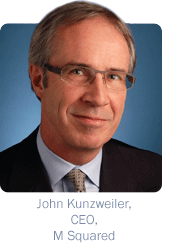
 The days of a career in consulting requiring a lengthy commitment under an executive pecking order are over. Nowadays, seasoned veterans of the profession looking to take the steering wheel on their career path are opting to strike out on their own, eschewing the convenient infrastructure put in place for them at larger firms in favor of a self-driven model. M Squared is one of the companies at the forefront of this contingent workforce trend. John Kunzweiler joined the firm in 2010 as CEO after 26 years at Accenture, and shared his insights about the direction of the free-roaming indy consultant, as well as some of the challenges and opportunities that they face.
Consulting: How does M Squared utilize the contingent workforce?
Kunzweiler: Our business model utilizes the high-end of the independent consultant population. Essentially, we staff them on individual or team-based projects. The main focus areas of our business are project management, business analysis, change management, and executive communications. Very focused model, we have 4 verticals: healthcare, financial services, technology and energy. It's kind of hard to describe, when people say what do you guys do, are you technology guys? We say we're more agnostic to what exactly we're doing but focus on those 4 areas and we find it to be a good market.
Consulting: How has the market for contingent workers changed over the past few years?
Kunzweiler: Both the positives and negatives continue to grow. By that I mean, for the positives, on the client side, more and more particularly of the larger businesses realistic in informed strategies on human capital and human capital utilization that continues to evolve very positively. They really do see a clear role for the contingent worker in how they get their work done at their business. Even though the economy is recovering, I think management is still cautious for because of an increasingly wired world; the always-on, instant communications world does drive a lot more volatility confronting management and companies. How they deal with that when it comes to human capital is to be much more conscious about full time employees, contingent workers and how they allocate the work that needs to be done. On the talent side, the trends continue. People see the traditional employee-employer deal is a lot less than it used to be, and that a lot of people feel more comfortable striking out on their own. The main concern they have is how to stay busy. That's where businesses like ours have a great role because we are the ones who keep those independent consultants happy, busy, and well fed.
Consulting: Do people choosing to do the independent consulting route to be younger consultants or more seasoned veterans?
Kunzweiler: The segment of the market we see are the more seasoned veterans. We really go after people who have history and background. In a perfect world, I think the opportunity for somebody like us is to cultivate the more recent graduate school and college graduates but that takes a training capability but even training has changed because it's all online, all our training at Arthur Andersen a hundred years ago was done in a little place outside of Chicago called St. Charles. Those days are past us. I think there's always a misconception that a smart guy or gal ergo is a consultant. That forgets the fact that consulting like a lot of other things is a profession that takes skills, takes experience, takes training. From my background I have a very strong appreciation for the importance of training. I think the successful consulting firms of the future will have really cracked the code of professional development, traditional training skills and enhancement. That continues to be critical. There's not a natural-born consultant. You need to learn this business, and it takes time.
Consulting: How are the market opportunities?
Kunzweiler: In our service areas, I think the opportunity continues to get better. Increasingly companies look at work in a different way. They've really project-ized work in a business. Rather than saying these are all processes and I have a staff of people and they do this kind of stuff, our clients have a mentality to package work up as projects, so it's easier for them to hire either internally or externally to do that. The volume of projects, particularly even small projects, continues to grow and grow rapidly. Change management is a better market than ever because I think people are really coming to grips with some of the hard change journey issues, that's a very strong market for us. The real surprising area for me is the whole area of executive communications. This is where we have senior-level writers working with the most senior level executives on complex and nuanced communication activities. You know how important it is for the leadership of organizations to communicate strategy, practices, policies, market perspectives clearly. That takes a team of people.
Consulting: What are some of the big challenges?
Kunzweiler: What makes the business tough is that companies are beginning to look at their spend on contingent labor and saying wow this is growing really fast. So the ugly side of my life is dealing with vendor management, vendor services, the clients will say 'well, we think this is the price for project manager', so you have that whole dialog going. That affects Accenture and affects M Squared. Particularly, the little guys don't have as much clout with the procurement guys, that's the hard part of the business. It's not a question of who is right or wrong it's really a question of maturity. As they become better buyers of human capital they will have to take a little more insightful approach to the procurement of human capital. It's not just a matter of declaring here's the price, here's the contract terms, take it or leave it, because contingent workers will leave it for better opportunities.
© Arc, All Rights Reserved. Request academic re-use from www.copyright.com. All other uses, submit a request to TMSalesOperations@arc-network.com. For more information visit Asset & Logo Licensing.