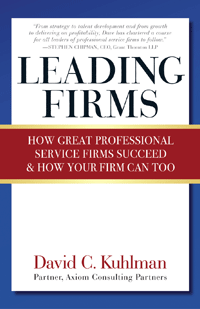
 The following is an excerpt from Leading Firms: How Great Professional Service Firms Succeed & How Your Firm Can Too by David C. Kuhlman. In the book, Kuhlman distills 25 years of
experience advising senior management at some of the world's most prominent consulting firms. This excerpt from Chapter Six: "The Growth Engine" explores two of the key factors driving growth in the most successful firms.
Chapter 6:
The Growth Engine
The capacity to grow differentiates firms from one another but growth does not. Every firm has a Growth Engine, but in most organizations it sputters along fueled only by the natural impetus to grow and sometimes even working against it. Using the firm's growth engine as a differentiating capability requires focusing on the right kinds of growth for the right reasons and then removing impediments to natural growth. Enabling and enhancing the natural forces at play in moving the firm forward creates momentum and an expansive culture that ultimately separates one firm from another.
In this sense the growth engine is not just about economic growth; it is about the firm's ability to expand, explore, and renew itself continually. This capability, this orientation, improves relevance to clients, creates an impatience for personal growth versus ladder-climbing, and encourages a self-reinforcing culture of success.
Thinking Differently About Sustained Growth
At the highest level, the growth equation for a professional service firm is very simple:
Growth = Increased Revenues per Principal
x Increased Number of Principals
 Revenues per Principal is a composite of all principals, some of whom are having strong years, others are not. Some principals appear to have topped-out, having reached some sort of maximum capacity, although the level of the plateau varies. Others seem to break through, and the reasons are often not quite clear or have no pattern. Identifying the dead wood is often difficult and dealing with it is a perennial challenge. Very few firms systematically focus on expanding the revenue-generating capacity of their principals: the most common approaches include training, generalized encouragement, and applying pressure through compensation.
The five specific ways to enable a firm's growth engine are:
• Systematically boosting revenues per principal
• Breaking the natural limits on principal productivity
• Creating an accretive new principal formation process
• Avoiding the pitfalls of direct-admit principal hiring
• Knowing the difference between good M&A and bad
Leading Firms examines each of these in detail. Here we examine two ways of driving growth that most directly affect most consultants.
Systematically Boosting Revenues Per Principal
Every professional is on a growth curve and as they progress along that curve, they generally become more productive. These increases in productivity show a general upward trend, marked by short-term variations and periodic plateaus as shown in Figure 1.
This "drunkard's walk" is generally accepted and as a result left largely un- managed in many firms. The belief is that the firm's desire for growth and the principal's interest in increased compensation create sufficient alignment. The irony is that the ups, downs, and plateaus happen despite this alignment.
Increasing revenues per principal is about recognizing this natural trend in individuals and maximizing the slope and speed each individual experiences. While some dramatic breakthroughs are possible, the real benefits are in small increments over a large number of principals and in the mindset it creates.
Systematically boosting revenues per principal across the entire principal group simply requires extending the proven tactics for improving individual performance across the entire firm. Every successful professional service firm leader has worked with individuals to shift their activities, develop growth plans and execute them, and conquer developmental limits. The growth opportunity for most firms is to do these things systematically, as a matter of course, until they become part of the DNA.
Coaching is for Principals, Not Just for Staff
The implicit belief in many firms is that principals are developmentally complete, self-motivating, and self-improving. An associated if seldom-declared belief says that all principals are partners together, are equal, and therefore criticism (i.e., feedback) would be unseemly. Basically, these arguments are simply rationalization for avoiding the discomfort that coaching brings. Most will admit there are things to learn and that can't be self-taught.
The solution starts at the top, purely and simply. The managing partner (or CEO) must consider himself/herself "Coach in Chief " to his or her direct reports. It is not enough to "hold leaders accountable to coach their principals," since this accountability will almost never be honored where financial performance intervenes.
It has to be role modeled and pressured from above. If a leader coaches his/her subordinates on their management of their subordinates, then the subordinates will in turn learn to do it, increasing pressure at the next layer and so forth, creating a domino effect.
Focus on the Right Actions in the Short Term and Look for the Right Results in the Long Term
Many firms focus on short-term results and long-term development. They encourage growth through measurement, pipeline reporting, and weekly business development calls. These are useful practices from a business perspective but do little to expand individuals' business development capacity—every principal likely feels accountable for delivering their numbers already. Sustained individual growth requires behavioral change and a long-term program of action. Creating these changes requires diligence and focus that cannot be left to annual developmental reviews.
 Every principal should have a development and action plan geared to building their capacity and leaders should follow up on the actions and growth more than the actual results. Taking the actions should yield the necessary outcomes, but the results (viewed over the longer term) should be required as validation that the actions were the right ones and well executed, that the skills were indeed learned.
The key is to create a closed loop of accountability for growth: focus on doing the right things in the expectation of a good outcome, but if the good outcome does not come, then the actions were not the right ones.
Success Comes from the Top of the Funnel, Despite a Natural Pull to the Bottom
Maintain a constant
© Arc, All Rights Reserved. Request academic re-use from www.copyright.com. All other uses, submit a request to TMSalesOperations@arc-network.com. For more information visit Asset & Logo Licensing.