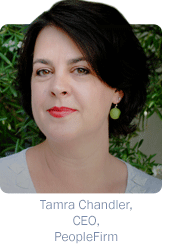
 Annual performance reviews are a time-honored tradition within consulting firms of all sizes, but the usual model is in the process of being up-ended. Innovations like crowdsourcing and social media are rapidly making the standard supervisor-employee model of performance reviews obsolete. Tamra Chandler, CEO of talent and change management consulting firm PeopleFirm, one of the firms leading this charge, says the old way of doing things is slowly, but surely changing, and that some companies are already ahead of the curve. Chandler spoke with Consulting One on One about this shifting landscape, and shared stories of some companies dipping their toes in the water, and others smashing the status quo.
Consulting: Are performance reviews effective the way they are presently conducted?
Chandler: We consult a lot of clients on what's the right approach to performance management. If you look across the world, 97 percent of the companies do it the same way, yet if you survey just about any employee or manager, no one will tell you it works particularly well. So you have to ask the question after doing it this way for so long and none of us can seem to get it to work well, maybe the design is inherently flawed. We've produced a point of view on that how you start to break the key things you're trying to do with performance management apart and address them more as standalone items.
If you're trying to develop people, how do you do that? If you're trying to drive strategy and alignment to goals, how do you do that? We've done a lot of that internally, so we've pulled it apart. For example, our consultants write an annual commitment letter. Saying, this is what I'm going to sign up for and do. Then we reflect on it. We don't have annual project reviews. When people start a new project, they will set their expectations in sort of a shared contract between the manager of the project and them which lays out, here's what I want to get out of this, here's what you need me to do, and how do we make sure we all win.
Consulting: How is the talent landscape out there looking these days?
Chandler: I think you're starting to see more reports coming out about the war for talent heating up. Before the recession there were a lot of articles published about the "brain drain" we're going to see from the baby boomers exiting and also the issue we have as far as the right skills not coming into the market. I think the recession muddied the waters and it became less of a crisis. The economy has to come back because the boomers are eventually are going to have to leave the market, not all of them are going to want to work until they're 80. We aren't producing enough skilled talent in any of the industrialized nations. It's going to become a battle. We think in the end, People is going to be the last competitive frontier. We think the competitive frontier is going to be your people, your culture and how you operate as a team.
Consulting: What's preventing major overhaul of the way performance reviews are conducted?
Chandler: I think you're starting to see some overhaul; a few companies moving away from the traditional system are getting a ton of attention. Adobe, for example has moved away. REI has started to move away, so you're starting to see some of those leading-edge companies step away from that tradition. You see a range of how far they're willing to move. Adobe pretty much just blew everything up. Some of the words they used were they "outlawed calibration" they don't want to be comparing people anymore. Some places you see people radically moving, others more subtly. Certain business processes are just so baked in, and performance management is one. Since no one's ever seen it done another way it really takes a while to realize they can do it a different way.
Consulting: Do you see there being any seismic shifts going into the future in how performance reviews are conducted?
Chandler: I think one of the things really helping sway it is social media. This idea of being able to listen to the crowd versus an individual is going to take over, particularly as the younger generations come up because they're much more comfortable with the idea of social media and crowdsourcing. I think you're going to see the idea that if we want to assess people or at least identify our high performers, letting the crowd do that produces a better result than letting an isolated manager do it. I think that's a big part of the trend you're going to see, the move away from this supervisor-employee peer relationship performance management because you get better answers if you include more voices in that process. I also think you're seeing organizations become flatter and more collaborative. I think you'll see more group measures.
© Arc, All Rights Reserved. Request academic re-use from www.copyright.com. All other uses, submit a request to TMSalesOperations@arc-network.com. For more information visit Asset & Logo Licensing.