 By David A. Fields
In the late 1970s, Princeton, N.J. oozed upper crustiness; a sleepy college town that perched like a yacht's captain above the sea of surrounding, middle class communities. Residents represented a comfortable mix of the cream of the crop: bow-tied, brainiac professors at the university, quirky savants at the Institute for Advanced Study (where Albert Einstein did his work) and blue-suited Wall Streeters who commuted to Manhattan while captaining industry.
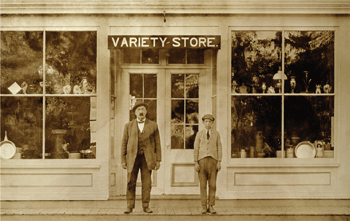
In the midst of such self-regard a men's dress shoe store could thrive, as was the case with Brophy's Shoes, established in 1896 and still puttering along at the tail end of a decade that boasted disco and silk-screened shirts. The lessons learned from peering in Brophy's front window apply far beyond the cultured confines of a privileged hamlet.
For eleven months of the year, Brophy's storefront looked much like you would expect, with a wide variety of oxfords and loafers in browns and black, plus saddle shoes and white bucks with red soles—shoes that might not sell in Pittsburgh, Peoria or Portland but were snapped up by preppies in pink trousers festooned with whales or crocodiles.
For one month each year, however, Tom Brophy stripped the window display of fixtures and expensive, leather shoes. In their place he positioned a decaying, well-worn pair of wing tips and a classic, wooden radio. Fronting this spartan presentation was a small, white card explaining in simple type, "Radio purchased in 1926—doesn't work. Shoes purchased at Brophy's in 1926—still being worn."
Passers-by halted mid-stride to gawk at the window, which was so unlike any other display on the retail strip. Their puzzled looks quickly melted into smiles and laughter that attracted others to pick up on the joke too. Store traffic tripled during those four weeks and many unlikely shoppers poked their head in the door to comment favorably on the clever arrangement. Eventually, though, the novelty of the storefront would diminish and Tom would restock his display case with shiny, supple representatives of his wares.
What I learned from Brophy's window applies well to consulting, which is a marketing-oriented business.
Among the Lessons:
Simplicity Begets Interest and Appreciation
• The world is cluttered and most people are so deluged with information from vendors eager to pitch their benefits that austere communication can cut through the noise. Chip away at your sales language like Michelangelo facing a marble block, leaving only the well-formed, attention-grabbing core.
• Keep it simple on your website and your marketing materials. (Compare www.sethgodin.com to www.jkrowling.com/en_US/. Seriously, when you need an overlay to explain how to use your website, isn't that a sign something's wrong?)
• Keep your value proposition simple. Ideally, you can express your message in seven or fewer words. Brophy's sold fine men's shoes. Target and offering captured in three words. How close can you get?
• Make your deliverables simple and clear. Marketing doesn't end once you convert a prospect into a client. Simple and magnetic are the watchwords for your results presentations too.
People Love a Story
• Communicate your best advantages with a story. Brophy didn't simply state that his high-price shoes would last a long time, he spun a tale from two, well-worn relics.
• Keep the story simple. You're not trying to pen the great American novel or win a Pulitzer prize. The shoe-store display communicated an entire story with a handful of words and two props.
• The story has to have a clear point—your point. People will forget the message and remember the story, therefore, you need the story and the message to be inextricably linked.
• Use vivid imagery. Ratty shoes and old radio. Enough said?
• Leverage the element of surprise. Mundane and familiar are forgettable. Incorporate the unexpected to make your message memorable.
Buyers Respond to Proof
• Purchasers are naturally skeptical and distrustful. Evidence, such as a 50 year-old pair of shoes that is still being worn or your own case studies and testimonials, counteracts these negative views.
• When a prospect encounters proof of your value proposition, he mentally shifts from, "Is that true?" to the questions you want to hear: "Why?" and "How?"
• Demonstrating that someone else has tried your offering and succeeded is worth its weight in gold. No one wants to be first into the pool. (Piling on the proof can amplify your effectiveness because no one wants to be last into the pool either.)
If the same traffic repeatedly receives your message, the narrative must change to add value.
• Even great marketing and messaging must be updated from time to time unless you are constantly approaching new audiences. The Planet of the Apes' Statue of Liberty scene may have compelled you to watch the movie a second time, but instead of a third viewing you sought the surprises in store in Butch Cassidy and the Sundance Kid.
• Return to great messages and recycle them. Brophy set up the shoe-and-radio display about once a year, always with great results. So consider: What meaningful, memorable messages can you bring back and use again?
Almost no upscale men's shoe stores remain in Princeton or anywhere else; however, the lessons from Brophy's window display still endure. You may be reluctant to strip down your marketing to its bare essentials out of fear that will leave almost nothing for potential clients to see. But that's the point: when there's almost nothing to see, prospects will love what you show them.
David A. Fields, author of The Executive's Guide to Consultants, is dedicated to making consultants successful. Get three free videos from his Irresistible Consultant Program at http://goo.gl/e8cmC. You can also email David at david@davidafields.com or call 203-438-7236 to inquire about him building a shiny, yellow object just for you.
© Arc, All Rights Reserved. Request academic re-use from www.copyright.com. All other uses, submit a request to TMSalesOperations@arc-network.com. For more information visit Asset & Logo Licensing.