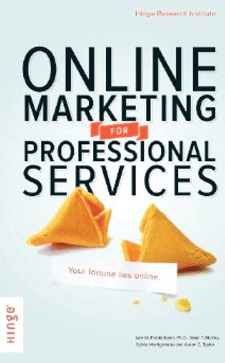
 The following is an excerpt from Online Marketing for Professional Services , a thought-provoking and practical approach to online marketing by authors Aaron E. Taylor, Sylvia Montgomery, Sean T. McVey and Lee W. Frederiksen. The following passage is from Chapter 6: Inside the Buyer's Brain.
Inside the Buyer's Brain
We are researching and purchasing everything else online. Why not professional services?
To understand the factors driving the revolution in professional services marketing, you need to understand what's happening between the ears of prospective buyers. At some point, an issue arises in their company that requires expert attention. What do they do? If it's an issue they don't completely understand, they'll likely turn to their computers (or tablets or smartphones) and Google it. In most cases, searchers will find a wide range of information that explains the issue. Often, the best information they find online is written by experts at firms that specialize in a related service.
Once educated enough to understand what kind of help they need, buyers will often turn again to a search engine (usually Google) to research firms that can help them solve their problem. Sometimes, that includes the firm that just educated them on the issue. They may also ask other professionals for a referral or post a question in an online forum.
Once they've compiled a list of promising service providers, buyers will check out these firms' websites, read LinkedIn profiles of key team members and look into references.
If all of this sounds familiar, it should come as no surprise. The process of finding information and relevant business expertise online is so easy, even senior executives get into the act.
And it's an increasingly common scenario being played out in organizations around the world. Why is this the case? What does it mean for your firm? Anyone who entered the workforce in the last decade grew up with digital devices.
The March of Technology
Today, we do things differently because we can. Over the last couple of decades computing power has become ubiquitous. The cost of global communication has plummeted. And the amount of information instantly available to anyone with an Internet connection is astonishing. Technology has even transformed social functions such as professional networking and communicating with friends. Witness the rise of social media. If you Skype with your grandkids, why not your clients?
But technology is only the start. Other forces are at work.
 Digital Demographics
Anyone who entered the workforce in the last decade grew up with digital devices. Just as an earlier generation grew up with telephones, today's young workers are completely comfortable with computers and mobile devices—and even take them for granted. They use these devices to communicate with friends and colleagues, check out movies and restaurants, buy books and music, and meet new people, maybe even a spouse. With technology so ingrained in our lives, why not use it to find or evaluate a new professional services provider? It's natural!
The Time Pressured Executive
Do more with less. Work smarter, work faster. Today's executives are under more pressure to accomplish more, faster than ever before. In a highly competitive global environment, there is little inclination to fool with time-consuming approaches to solving problems.
I want the solution now.
"I want the solution now. Who can solve my problem with minimal input from me or my team? We need a solution to our challenge that gives us confidence. Where can I find that firm with the minimum of hassle and time commitment?"
Online marketing offers an easy answer to this question.
Expectations of Free Education
When you go online you expect to find a wealth of educational material. The basics of almost any topic are literally at your fingertips. You may have to register—provide your name and email address, for instance—to access some resources, but that's a small price to pay for valuable information, especially if it can help your business. And certain in-depth materials such as books or proprietary research may require payment. But by and large, in the world of the Internet you expect to learn for free.
This experience has direct implications for your professional services firm. Do you want to be the place prospects come to learn about emerging issues? Or do you want them to go somewhere else? How much of your expertise do you give away? And what do you sell?
There was a time when the answers to these questions were fairly easy. If you wanted to tap into a firm's expertise, you needed to hire them. That's not so clear anymore. Today, hiding all your expertise behind a wall can put you at a decided disadvantage in the competition for new clients. If a competitor of yours is forthcoming and generous about educating potential clients and you are opaque, where do you think that potential client will turn when they need to hire expertise?
Expectations of Transparency
Who works at your firm? What are they like to work with? Who are your clients? How do you approach certain problems? In the past, many firms would have considered these questions sensitive and been loath to share.
But these days, many prospective clients see them as legitimate areas of inquiry. Prospects should be able to go online and learn all about your firm, philosophy and approach. If buyers can't easily access this kind of information, they are likely to pass you over for a firm that has nothing to hide.
Today's Internet-savvy buyers also expect to learn about a firm's strengths and weaknesses. After all, they can go online and find reviews of restaurants, physicians, books and new cars. Why not accounting firms or IT consultants? What are you trying to hide?
Geography is becoming less of a barrier to doing business.
A Global Marketplace
All of these trends tend to move us in a clear direction. Competition for professional services is expanding geographically—beyond a shallow pool of local providers. It's becoming easier and easier to find specific services anywhere in the country or world.
While there is no substitute for face-to-face interaction, businesses are becoming comfortable conducting business remotely. From services such as GoToMeeting, WebEx and Skype to the routine use of email and conference calls, geography is becoming less of a barrier to doing business.
Many professional services firms are already working with clients outside their local markets and developing specialized services that are more "exportable." Whether or not your firm has aspirations to expand geographically, you have competitors that do and potential clients who are comfortable trading local access for greater expertise.
The Specialist's Advantage
All of these trends point toward something we call the specialist's advantage. If a business is looking for a firm to solve a specific problem, it is more likely, given the choice, to select a firm that specializes in solving similar problems for clients like them—often with little regard for physical location. Thanks to the Internet, specialists are getting easier and easier to find and evaluate.
Generalists, even if they are local and have a good relationship with a potential client, may have difficulty competing against specialized firms. This inherent advantage may be one of the keys behind our finding that firms with clearly defined target clients and specialties tend to grow much faster and experience a higher level of profitability.
A Compelling Case for Online Marketing
With all of these factors favoring online marketing, one might expect to see a decided advantage for professional services firms that embrace it. As it turns out, that is exactly what we found.
Specialists are getting easier and easier to find and evaluate.
Key Takeaways:
• Technology, demographics and time pressure are driving buyers of professional services to look online for education and solutions.
• They expect to find a free education and world-class expertise.
• Specialists who are very visible and transparent about their capabilities have a competitive advantage.
• Geography is becoming less of a factor in buying decisions.
Excerpted with the publisher's permission from: Online Marketing for Professional Services.
© Arc, All Rights Reserved. Request academic re-use from www.copyright.com. All other uses, submit a request to TMSalesOperations@arc-network.com. For more information visit Asset & Logo Licensing.