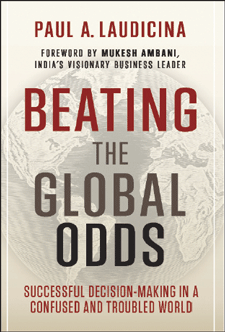
 When Paul Laudicina, Managing Partner and Chairman of the Board at A.T. Kearney, wrote World Out of Balance in 2005, things were very much still in balance. But Laudicina saw it differently and argued that the course we were on was unsustainable. As it turns out, Laudicina foreshadowed everything from the global economic meltdown to the Arab Spring. "It's looking at current developments and playing them out over 10 or 15 years, and trying to fathom what the world will look like. When I did that, it was pretty clear to me that it was unsustainable." Laudicina is back at it with Beating the Global Odds , a book that examines how we got to this point and takes a closer look at how some companies—including his own firm—managed to find success in extremely difficult economic times.
Consulting: Can you tell me a little bit about the origins of this book?
Laudicina: When I wrote World Out of Balance in 2005 things were going, by all regards, very well. But I wrote that it wasn't sustainable. And when I took over A.T. Kearney in 2006, the world was still on a high even though A.T. Kearney was the proverbial Phoenix at that point having been through the trauma of living the last few difficult years as a subsidiary of EDS. A lot of folks didn't give us very good odds, but a bunch of us decided to re-invest and restart the firm.
Consulting: How much does Beating the Global Odds rely on the premise of what you laid out in World Out of Balance?
 Laudicina: The first book was saying there are some fundamental imbalances in the world that were creating the illusion of value and wealth that was not built on solid ground. The culmination of that, I guess, was the collapse of Lehman Brothers in 2008 and the floor falling out of the global economy. A.T. Kearney was born the first time during the Great Depression and was reborn the second time during the Great Recession. In this book, what I tried to do was focus on the fundamental lessons that explain why the global economy collapsed in the first place and why some players—A.T. Kearney among them—have managed to beat the global odds and succeed despite all the gravitational pull that would seem to make that difficult to fathom.
And in a curious way, technology, which has brought us so much, has actually complicated our ability to make effective decisions and execute on them because the 24/7 bombardment of information has so muddied the waters to the point that rather than having clarity it has created a sort of data smog and made it more and more difficult for people to make decisions. We're just now starting to come out of the foxhole and looking around and we're searching for clarity, and we've got all this information, all these mountains of data around us and we can't make sense of it all. So the question is: How do you cut through it all? How do you get the clarity that you need? How do you get out ahead of the crowd? That's what the book is about.
Consulting: Where did we go wrong? Where did we go off track?
Laudicina: There is no one point in time. I think it is a combination of things: We went through some periods of meteoric growth where, in a very unregulated environment, people were creating sophisticated instruments for wealth creation that really delivered no value but were intent on continuing the Ponzi scheme of paying it forward without value being added along the way. At the same time, the political system lulled itself into thinking it could just step back and watch it all happen. We kind of all took our eye off the ball. Business became distracted by high growth rates. Consumers assumed they could borrow more and spend more. We were all living beyond our means and tricking ourselves that this could go on forever. And once the bonds of trust were broken, the whole system collapsed.
© Arc, All Rights Reserved. Request academic re-use from www.copyright.com. All other uses, submit a request to TMSalesOperations@arc-network.com. For more information visit Asset & Logo Licensing.