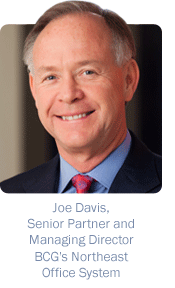
 The always-connected workforce has it advantages, for sure. Round the clock access to clients, and other employees, is the way much of the world works. But at consulting firms, where work/life balance is usually already an issue, that 24/7 connectivity can be very damaging to morale and culture. "I think it got way out of control at BCG," says Joe Davis, a Senior Partner, Head of the East Coast region and Americas leader of The Boston Consulting Group's Public Sector practice. "Smart phones completely changed the culture. People always worked a few hours here and there on the weekend but it went overboard." The result was regrettable attrition. BCG was losing high-value people. To combat the problem, BCG embarked on an innovative program it calls PTO, which stands for Predictability, Teaming and Open Communication. The program was piloted in the firm's Boston office seven years ago and has been rolled out throughout most of North America and Europe. Davis will walk us through the PTO program as part of his "Working Smarter: How BCG Redefined Employee and Client Satisfaction" presentation at the Consulting Summit in New York on Oct. 25. Davis sat down with Consulting One on One to talk about the PTO program.
Consulting: Why did BCG adopt the PTO program?
Davis: A consulting firm simply can't have attrition of its high-value employees and the No. 1 reason people leave the firm is because of work/life balance issues. We thought it was getting out of control at BCG so we hired a Harvard professor to take a look at it for us. Smart phones were, essentially, putting people on call all of the time. We lost control of work/life balance. People were monitoring their smart phones around the clock and that can be pretty painful. That also contributed to the unpredictable nature of the job, which was something our people were saying was frustrating about their work.
Consulting: And those frustrations were impacting employee morale?
Davis: Here's a perfect example: We had a consultant who would take his small child to soccer on Saturday mornings and would bring his smart phone with him. Well, every Saturday he would get a bunch of messages from a Partner and he would feel pressure to respond to them. Therefore, he'd feel like he had a whole new workload on Saturday. Meanwhile, the Partner also had a small child who happened to take naps at that time on Saturday mornings so he'd be able to get a bunch of work done at that time. The Partner, by no means, expected anyone was reading those messages on Saturday morning and no expectation that they'd respond to it. This was causing all kind of anxiety on the part of this consultant, and others, who were getting these Saturday morning messages.
Consulting: So, how does a situation like that get resolved?
Davis: Well, we addressed it through the PTO program and we did a couple of things. One, and this is very difficult, is we insist that everyone takes one night a week off. That means no e-mail, no smart phone, no checking at all—even if they are on the road, we want them to take the night off. That's easier said than done, by the way. But we mandated it as part of this PTO program. There was a lot of resistance to that initially, and people, I think were worried that would just lead to more to do the next day or over the weekend. But those ideas in PTO—predictability, communicating and teaming—make it possible. Once the team knows what night you're taking, we can cover for you and vice versa. And it's predictable, so you can plan around it. That's been one of the big keys.
Consulting: How do you implement something like this?
Davis: The team needs to sit down before the project starts and communicate with one another about how they prefer to work. We had one recent example, for instance, of a partner who starts work really early. We all discussed and made a deal: No one on the team was going to answer an e-mail from him before 8 a.m. We made a similar rule for those who like to work really late. And we've really worked hard to protect weekends. The open communication part is worth amazing amounts and is probably the biggest reason we've had success. What we've also done, which is a little costly, is train PTO facilitators to run each team. Those facilitators do interviews with the team members to find out their preferences and priorities and anything they may not want to disclose in front of the team. These are internal BCG folks we pull off consulting assignments for three to six months. These facilitators go through extensive training and then the facilitating aspect. What we find is that they come back as better managers after the fact.
Consulting: What's been the hardest part of rolling out the PTO program?
Davis: The hardest thing is getting the partnership and partners to want to do it and believe that it will make a difference. Some people, truth be told, have to be convinced. A few of them actually think we're wasting time and we're wasting money on facilitators. We've done this office by office and team by team and we've rolled this out to about 65 percent of BCG by now and the results are astounding. We see the difference and we have the data to back it up. Where we've rolled this out we've already seen the needle move on our internal surveys on conditions of quality of work/life balance.
For additional information about the Consulting Summit or to register, please visit www.consultingsummit.com.
© Arc, All Rights Reserved. Request academic re-use from www.copyright.com. All other uses, submit a request to TMSalesOperations@arc-network.com. For more information visit Asset & Logo Licensing.