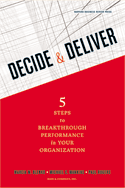
 The following is an excerpt from Decide & Deliver: 5 Steps to Breakthrough Performance in Your Organization by Bain & Company authors Marcia Blenko, leader of the Global Organization practice; Michael Mankins, leader of the Organization Practice in the Americas and a key member of the firm's Strategy Practice; and Paul Rogers, former leader of the Global Organization Practice and current Managing Partner for Bain's London office. The authors draw on Bain research and know-how to present a five-step process for improving a company's decision abilities and argue that "decision management" can be a potent competitive tool.
Chapter 1:
Decisions and Results
Trevor Gregory was frustrated. A senior executive of ABB UK, the British division of the big Zurich-based power technology and automation company, Gregory was racing to put together several critical bids for clients, including the Channel Islands electricity grid, London Underground, and National Grid. The opportunities played to all of ABB's strengths as a global engineering colossus—they required technologies, project delivery, and services from several parts of the company. Few competitors could match these soup-to-nuts offerings.
The contracts would mean hundreds of millions of dollars in revenues for ABB over many years. But instead of cruising through, Gregory was bumping up against one organizational obstacle after another. The company seemed to reinvent the process for submitting major bids every time a bid came up, even though multimillion-dollar proposals like these were regular events. Worse, each of ABB's units had its own profit targets and set its own transfer prices, including a margin acceptable to that unit.
By the time a bid got through the chain of ABB units, the end price was often too high to be competitive. Gregory and other managers then faced an exasperating choice. They could go in high and lose the business. They could walk away without bidding. Or they could invest blood, sweat, and tears in trying to pull the bid together, piece by laborious piece. These opportunities are really important, Gregory thought to himself. We've got to make them happen. But he dreaded the arduous internal negotiations required to assemble the bids. Why on earth, he wondered, didn't his company work better? Why wasn't it set up to make good decisions on a routine basis for the benefit of the whole business?
 This book is about how to fix decision failures like the ones that plagued ABB. It's about how to create an organization that hums—one that can make and execute good decisions, faster than the competition, and without too much (or too little) time and trouble.
ABB's situation was particularly severe, as we'll see in a moment: its decision failures led it to the brink of bankruptcy. But most failures are chronic rather than acute, and they show up in many companies, not just those that are courting insolvency. The signs are familiar. Decisions take longer than they should. They are made by the wrong people or in the wrong part of the organization or with the wrong information, and so turn out badly. They aren't made well, because no one is sure who's responsible for making them, or because the organization has created structures or incentives that virtually guarantee a poor outcome.
 Sometimes, of course, decisions are made, maybe even in a timely fashion. But then they are badly executed. Or else the debate starts all over again and they are never executed at all. No company can live up to its full potential unless it can decide and deliver. Good companies can't become great. Troubled companies can't escape mediocrity. And it isn't just financial results that suffer. Organizations that can't decide and deliver are dispiriting to their employees.
From the C-suite to the front line, people feel as if they're stuck in molasses or trapped inside a Dilbert comic strip. Aggravations and absurdities abound. The European division of an American automaker, for example, repeatedly lagged behind competitors in bringing out new features on its cars. The reason? Marketing thought it was in charge of deciding on new features.
 Product development thought it was in charge. The two functions had different incentives—marketing's were primarily on sales, product development's on costs—and so could never agree. Every proposal had to be thrashed out in long, contentious meetings. It isn't hard to imagine how the people in these functions—indeed, pretty much everybody in the organization—felt about coming to work in the morning. But things don't have to be that way.
For more than twenty-five years, the three of us have consulted to organizations of all sorts. Our clients have included large multinational corporations, entrepreneurial ventures, research universities, and nonprofit institutions, and we have worked with leaders at every level. Despite their differences, we noticed, all these organizations share one consistent trait: when they focus explicitly on decisions, the organizations learn how to improve their performance.
As their decision making and execution get better, so do their results. They can pull themselves out of the kind of downward spiral that ABB was caught in. They can create great working environments, which in turn attract the kind of people who get things done. They build the organizational capabilities to decide and deliver time and time again, in every part of the business. That, we saw, is the key to sustainable performance.
Over time, we worked with enough organizations that we began to see how to systematize this approach to decisions and performance, how to map it out and capture it in a sequence of steps. We conducted a series of research studies to validate and extend these insights. We published many of the ideas in Harvard Business Review and elsewhere and then refined them in light of feedback we received from executives. (See, for example, "Who Has the D? How Clear Decision Roles Enhance Organizational Performance" and "Stop Making Plans, Start Making Decisions," both in the Review's January 2006 issue.)
© Arc, All Rights Reserved. Request academic re-use from www.copyright.com. All other uses, submit a request to TMSalesOperations@arc-network.com. For more information visit Asset & Logo Licensing.