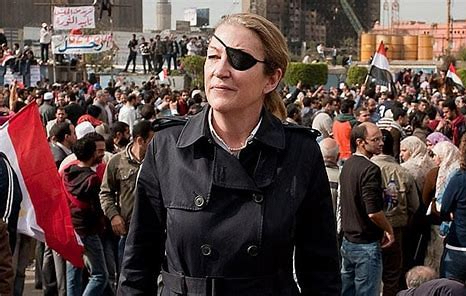
 What is the value of a human life? Insurance executives and safety analysts deal with this question regularly, but for most people, it's a difficult if not impossible task to say how much a life is worth, especially a life as extraordinary as that of American journalist Marie Colvin.
In 2012, Marie Colvin was killed while covering the siege of Homs, Syria, for the British newspaper The Sunday Times. French photojournalist Rémi Ochlik was also killed during the bombardment. Marie's family filed a lawsuit in 2016 against the Syrian government, claiming Syrian officials used intercepted satellite phone signals to target and kill Marie to silence her reporting on Syria and the besieged city of Homs. The case received significant media coverage, and Marie's story was retold in the recent biographical feature film "A Private War," in which she was portrayed by actress Rosamund Pike, in a Golden Globe-nominated performance.
Henry Weisburg, a senior partner at Shearman & Sterling who represented Marie Colvin's family along with a team from the Center for Justice and Accountability ("CJA"), approached FTI Consulting in 2017 for assistance in calculating the economic losses for the case. Because of my decade-plus of experience in valuation, accounting and auditing in Europe and the United States and my knowledge of international law, I was chosen to lead the pro bono project, which turned out to be one of the most interesting and personally fulfilling assignments of my career.
Putting the "her" in "hero"
Marie Colvin was not an average American citizen, nor an ordinary foreign correspondent working abroad. Her trademark black eyepatch, which she wore after losing her left eye to a Sri Lankan Army rocket-powered grenade, attested to her courage and selflessness in bearing witness to conflict around the globe. In East Timor, she was credited with saving the lives of 1,500 women and children who were besieged in a compound by Indonesian-backed forces. While 22 journalist colleagues evacuated, she stayed on with an unarmed United Nations force and continued to report on their plight until they were evacuated to safety four days later.
She was twice named Foreign Reporter of the Year (2001 and 2010) in the British Press Awards. She was given an International Women's Media Foundation award for courage in journalism for her coverage of Kosovo and Chechnya. The Foreign Press Association named her Journalist of the Year in 2000.
For the task at hand, my job was to come up with an economic value of Marie's life that was lost when she was killed in Syria. The usual due diligence of reviewing the estate accounts, financial securities statements, tax documents and employer policies provided a starting point. Beyond that, I had to think through every relevant aspect of her life, envision every related detail, and understand the industry she worked for, as well as her professional aspirations. To fully quantify the economic losses arising from Marie's untimely death, I drew on my education and experience to develop a unique model based on primary research and information specific to her situation.
Quantifying the risk of conflict zones
While standard valuation methodologies applied to most of my work, there was one part that was unique: creation of an entirely original model to estimate the probability of a foreign correspondent being killed in a war zone. In Marie's case, I also took into consideration her celebrity as a widely admired, award-winning war correspondent and the supplemental income-generating opportunities that may have come her way, such as possible freelance work on books and documentary films.
To create my "war zone" risk model, I started with a baseline assumption gleaned from government health statistics that Marie would normally have been expected to live until age 84. Then I had to consider the annual average probability of death as a foreign correspondent working in a conflict zone. To come up with this measure, considerable research was required to determine:
• The average annual number of American foreign correspondents and reporters killed globally per year on dangerous assignments, from data compiled by the Committee to Protect Journalists;
• The total number of full-time foreign correspondents employed by U.S. newspapers, taken from the American Journalism Review; and
• The approximate number of full-time foreign correspondents working on dangerous assignments, as compared to all full-time foreign correspondents, and what portion of the year they were in dangerous situations. This data was derived from numerous interviews with currently employed journalists.
My analysis of death rates for reporters since 1992 showed that American correspondents are more likely to be killed in war zones than other nationalities, and I conservatively used this higher probability because Marie held a U.S. passport.
A missed retirement plan
At the time of her death, Marie had no thoughts of retirement – quite the contrary, both her sister and employer stated that they believed Marie would have worked for as long as possible, and despite past injuries, she was in generally good health. Because Marie never talked about her retirement, I had to use the available data and my own judgment to determine what her retirement years might have looked like, so as to apply the "war zone" risk adjustment only to those years prior to her retirement.
Based on the statements of people close to Marie, her employer's retirement plan documents, and my analysis of retirement ages and relevant laws in the UK, I identified two possible ages when she might have retired – 65 and at 70. The judge agreed on 70, as she didn't have any plans to retire earlier. However, considering that it would have been hard for her to work in war zones after age 65, I provided the Court with an estimate based on Marie retiring from work in conflict zones by age 65, even if she continued to serve in other roles as a journalist.
Final calculations and outcome
My expert opinion was only one small part of the painstakingly thorough case that CJA and Shearman & Sterling presented to U.S. District Judge Amy Berman Jackson of the District of Columbia, documented by more than 1,000 pages of exhibits, declarations and expert reports. Based on a gross earnings approach and projections related to Marie's employment, but without accounting for other potential and likely income from other media projects, I calculated the economic loss from Marie's death as more than $2.3 million had she instead retired at 70. At the Court's request, I also adopted a "net loss" model incorporating an adjustment for "personal consumption," resulting in a loss of $1.1 million.
In February 2019, the Court accepted my methodology and awarded actual economic damages of $1.1 million. That figure was added to the $300 million in punitive damages assessed by Judge Jackson, due to the "outrageous" nature of the extrajudicial killing. While the Syrian government declined to participate the proceedings, the punitive award is not merely symbolic. Mr. Weisburg's legal team will be attempting to collect the judgment from various extraterritorial Syrian assets on behalf of the Colvin family members who are beneficiaries of Marie's estate.
I recently watched the movie "A Private War" and saw Marie's life played out on the screen. I'm proud that my work contributed to a satisfactory conclusion of the case. Yet no matter how accurate my valuation could be, it will never include the personal loss felt by Marie's family, and the blow to international journalism and free societies when we lose heroes like Marie Colvin.
Dr. Maria Tsennykh is a Senior Director in the Forensic & Litigation Consulting segment of FTI Consulting, Inc. She is based in New York. FTI Consulting, Inc., including its subsidiaries and affiliates, is a consulting firm and is not a certified public accounting firm or a law firm. The views expressed herein are those of the author(s) and not necessarily the views of FTI Consulting, Inc., its management, its subsidiaries, its affiliates, or its other professionals.
© Arc, All Rights Reserved. Request academic re-use from www.copyright.com. All other uses, submit a request to TMSalesOperations@arc-network.com. For more information visit Asset & Logo Licensing.