Buffeted by slow growth and competitive markets, businesses across the globe desperately need to change the productivity equation. The U.S. Bureau of Labor Statistics reports that average annual manufacturing productivity growth during the post-crisis period is half the rate of the 1990s and pre-crisis 2000s. The multifactor component of productivity growth that captures changes not accounted for by labor and capital such as technological innovation and changes in the organization of production actually declined outright during the post-crisis period. Absent the ability to get more out of their production and human assets, companies cannot free up the resources they need to bring innovative products and services to new markets and customers.
Strategy & Operations (S&O) consultants are attacking this challenge in two new ways. One, they are helping their clients deploy new production technologies such as additive manufacturing, advanced materials, and Internet-of-Things connectivity. Two, they are developing advanced analytics tools to help their clients to harness and derive insights from the increasing volume of data thrown off by their manufacturing operations. But the playbook used by most consultants for adapting the organization of production, the manufacturing system, is an old one: lean waste reduction and continuous improvement.
While it is also pushing new production technologies and advanced analytics, motivated by two distinctive points of view EY is doing something completely different when it comes to the manufacturing system. On the one hand, the firm believes consultants and their clients too often focus on achieving operational agility through synchronized planning and sophisticated reliability engineering techniques without attending to the prerequisite for sustaining gains from these advanced methods: operational stability. On the other hand, the firm holds that instilling that stability ultimately depends on engaging operators on the shop floor and changing behaviors.
P&G's Integrated Work System
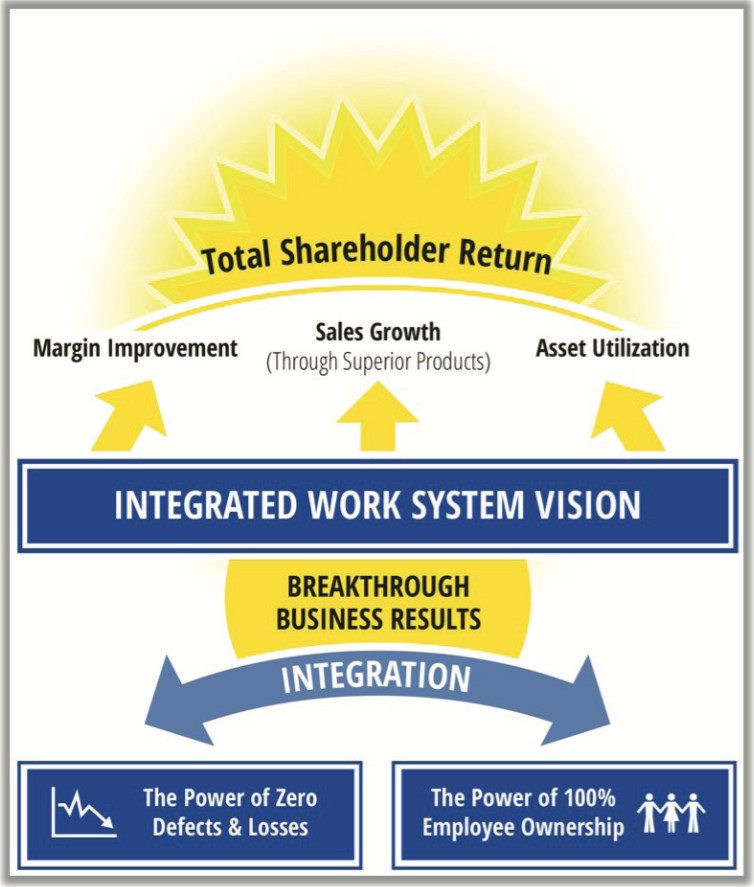
To deliver this approach, EY formed an alliance with P&G in 2013 centered on the latter's Integrated Work System (IWS), a manufacturing excellence program assembled over more than 20 years through the accumulated learning from applying various manufacturing systems, including lean, Total Productive Maintenance (TPM), Reliability Engineering, and the Toyota production system. While these systems individually yielded incremental performance improvements, P&G's IWS seeks to harness elements of all of them through a disruptive new way of working predicated on zero losses and 100 percent employee ownership that delivers breakthrough operating and financial results. To wit, the company's plants operate at more than 85 percent Overall Equipment Effectiveness (OEE) against a 55 percent industry average and the most advanced sites are "cash positive," selling before they buy.
Servant Leadership. IWS turns upside-down the traditional hierarchy, charging managers with developing and enabling operators by getting out of their offices and onto the line, observing operations, asking questions, and coaching and training to reinforce a culture of operator empowerment and continuous improvement.
Operator Equipment Ownership and Technical Mastery. IWS holds that the job of equipment operators is to not only run their machines, but also maintain them in base condition to increase uptime. For this, operators need new skills. The first step is to educate the entire organization on the definition of a loss as a source of waste. From there, operators obtain autonomous maintenance capabilities together with the responsibility and authority to identify, prioritize, and eliminate the losses that impede machine uptime. The upshot is that operators work more with their heads than hands, freeing up mechanics to concentrate on preventative maintenance activities that can drive productivity rather than responding to unplanned downtime.
Analytics for Stability and Predictability. Built on a 20-year collaboration with the Los Alamos National Laboratory, P&G's Reliability Technology is a method for analyzing failure modes of all components of the production line that can "learn and adapt" based on data from actual production runs.
Standards and the Daily Management System. To make productivity gains sustainable and instill continuous improvement, IWS employs rigorous problem-solving and standard-setting and embeds them in daily routines. As operators detect losses, they follow a strict troubleshooting protocol focused on fixing them right the first time and crucially update standards for any fixes. A daily direction setting process reinforces loss elimination goals in daily shift planning and ensures that new losses and standards are communicated between shifts, fostering peer-to-peer engagement and more self-sufficient teams.
Phased Roll-out. P&G implements IWS at new plants through a phased process based on a detailed mapping of plant maturity. The process starts by instilling an understanding in the plant leadership of IWS and the true state of current operating losses. Subsequent phases focus on achieving stability, extending uptime to free up resources, integrating the end-to-end supply chain, and fostering agility through predictable and flexible operations that can deliver innovative products.
EY's Alliance-based Model
The EY-P&G partnership is distinctive as a consulting model in a number of ways. One, it arms EY and its clients with a readymade database of intellectual property, consisting of over 1,000 capabilities developed over 25 years and battle-tested in more than 130 P&G plants. Two, EY codified IWS and devised a tailored consulting approach to rapidly deploy it at client sites without an army of consultants through a lead-line pilot roll out, targeted coaching interventions, and advanced analytics tools to prioritize actions. Three, P&G provides EY clients with access to its plants to demonstrate IWS and benchmark client performance together with peer-to-peer connections designed to support EY clients on their implementation journeys.
While some S&O consultants have adopted elements of this model, EY's is unique for its comprehensiveness and actionability. What really animates it is the engagement of EY's partner, P&G. Lots of firms call on best-in-class companies or former clients to demonstrate results to new ones, but few can do this in an industrialized model that is systematic and repeatable. Essential to this relationship are the benefits that accrue to P&G. In addition to a new revenue stream generated by licensing IWS, P&G has access to the codified materials and consulting approach EY developed and, as a strong proponent of open innovation, benefits from the opportunity to learn and improve IWS through the experiences of a more diverse population of users.
While the attributes of manufacturing systems—things like 5S in lean—are readily transferrable, the cultures that animate those systems are notoriously difficult to replicate. This partnership has been around for several years now and is delivering. Examples of companies that have licensed and are using IWS, including British American Tobacco and Kraft, cross industry sectors and geographic regions. Indicative results include 20 point gains in OEE and 50 percent reductions in unplanned downtime over 18 months.
With a holistic approach that brings together the combined know-how of S&O consulting and best-in-class manufacturing, the EY and P&G partnership offers a compelling escape from the productivity crisis.


Nathan Simon is the Director, Lead for Strategy & Operations Consulting Research. Naima Hoque is a Research Analyst, Strategy & Operations Consulting Research.
© Arc, All Rights Reserved. Request academic re-use from www.copyright.com. All other uses, submit a request to TMSalesOperations@arc-network.com. For more information visit Asset & Logo Licensing.