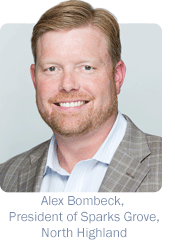
 It's no secret that analyzing and parsing through the massive pile of data companies accumulate through the natural course of doing business has become a huge industry. But very often in an organization's social strategy, the left hand is not talking with the right. This could mean key insights are going by unnoticed, which could mean customers slipping away as their needs go unmet. To bring all the parts together, North Highland recently launched its Social Insight Lab to harness the power of social to make sense of the data, and make it profitable for clients. Alex Bombeck, President of Sparks Grove, North Highland's marketing division, sat down to explain how it works.
Consulting: How did the Social Insight Lab come to be?
Bombeck: My background is global advertising, and as the Chief Digital Officer at a global ad agency I had teams that ran social community management and we worked closely with clients to develop social programs. Social was really taking foot in customer service and risk mitigation. These are great, but are typically all done by separate organizations: customer service handles their end, risk mitigation is usually corporate communications, and they look at that to make sure people aren't saying anything negative, or if there's an announcement what the fallout—or positive—benefit of that announcement was. But none of this was being handled in a single contiguous way that was going to give true business insight and really help the organization itself. The intent behind the Insight Lab is the ability to marry these data points to begin to get new insights. It gives us the opportunity as an organization to actually get access to those sets of data in a single location that we use in the way we look at our clients' challenges.
Consulting: How does the Insight Lab fit into North Highland's Analytics strategy?
Bombeck: I would almost position the Lab as a meeting point of where the various analytics capabilities come together. Our analytics division has seats within the lab and is an integrated part of the team. While we have people dedicated to working there, we have a fairly fluid team that sits within the lab. That allows us to bring the "house"—all these distinctive skillsets—together. Marrying traditional social data with CRM data with search data with blog information was the premise behind it. That's really where we're seeing success with our clients, helping them create connections between their social activity and how that might be impacting sales on the other end. We can connect those dots. Community management typically gets very focused on things like engagements, retweets, Likes—things I would consider to be relatively one-dimensional social data.
Consulting: How does this impact North Highland's effectiveness on engagements?
Bombeck: At pure face value, it's an area that if you aren't having a discussion about it, you're not being contemporary in today's business world. From our point of view, it's a great conversation starter. If you ask a client 'what are you doing with your social data or how are you leveraging social platforms to improve your business performance?' nobody is going to say they don't want to talk about it. Nobody. From that perspective it's working pretty well. The Lab has a couple of standard offerings. One of the things we found with social is that it's a pretty amorphous topic. Depending where you sit it can mean one of many different things. To that effect, when we talk about social we're starting with standing up some offerings for clients. Those offerings include things like event management or event monitoring, topic or issue analysis, where we're able to focus in on a client's product launch announcement. Influencer evaluation is another area we're looking at. We tried to start with some, if you will, "packages" which allow clients to begin to understand how to use this data to drive business value. What's particularly important for us is to understand how we're going to be applying the Insight Lab and its capabilities to driving business value in a meaningful way.
Consulting: How do you picture the lab evolving over time to adapt to the changing challenges of social?
Bombeck: Currently there is more data than we can handle. For example, "dark data," which at first sounds mysterious, but isn't at all. There's a ton of it, we just don't know how to bring it into the conversation and into the analysis. It's readily available; we just don't know what to do with it. It's ancillary data being generated all the time because everything we do is networked. For example, when retailers are using beacons, they're using them to push messages within a retail environment. But at the same time those beacons are also able to connect with that individual on who they are. If you were to partner that retailer with an AT&T for example you're going to have a whole other set of data you can compile that the retailer isn't using. They have no interest in it. They're just using beacons to push messages. But in fact if you take the beacon technology and the data it's creating, and put it together with the AT&T data that exists within that user, and there's a whole new set of information we could look at. And we don't today. That's a core feature of the Insight Lab: how can we bring core data streams together in a meaningful way.
© Arc, All Rights Reserved. Request academic re-use from www.copyright.com. All other uses, submit a request to TMSalesOperations@arc-network.com. For more information visit Asset & Logo Licensing.