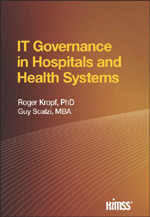
 How to ensure IT projects in hospitals and health systems are on time and on budget
Without a governance structure, IT management at many hospitals and health systems is a haphazard process that typically results in late, over budget projects and, ultimately, fragmented systems. Aspen Advisors principal Guy Scalzi and Dr. Roger Kropf, a Professor in the Health Policy and Management Program at New York University's Robert F. Wagner Graduate School of Public Service, tackle the governance issue head on with their latest book: IT Governance in Hospitals and Health Systems, published by HIMSS. The book, the second co-authored by the two healthcare IT leaders, offers a practical 'how to' guide to creating an information technology governance structure that ensures that IT projects supporting a hospital's or health system's strategy are completed on time and on budget. Consulting sat down with the two authors to discuss the book and IT governance in healthcare.
Consulting: You two teamed in 2007 on the book Making Information Technology Work. Why did you decide the write this book?
 Kropf: In one sense, this is a follow-up to that book. For me, one of the big reasons to write this book was based on work we did with a university hospital in Cleveland. Guy and his colleagues had helped the CIO develop the governance process, and I was fascinated with how they had come up with dividing the responsibility between the IT function and staff and the management staff. The CEO was head of the steering committee, which is not typical. I did a lengthy case study on it and thought it was really fascinating. That, combined with what we were hearing in the marketplace with staff being overwhelmed of late with too many projects and responsibilities. And I know Guy was also hearing that from his clients, too.
Scalzi: That's right. As a consultant, you often get request for proposals and then there's a long, long time before they are approved, a firm is selected and then the work begins. I started to wonder why that was and what I discovered was that so many of my clients were missing real governance. They had good ideas, they had needs they were able to articulate, but often they ended up starting the process with the RFP when it should be the other way around. They were really putting the cart before the horse so there was a tremendous need to explain governance. That was the missing piece.
Consulting: Why don't more hospitals and health systems have governance in place?
Scalzi: There's a lot of inertia. A lot of hospitals say: We're not a chain of command organization. There are a lot of priorities and we just can't be organized like this. And, there are also a lot of leaders who, quite frankly, like it the way it is. It allows them to do what they want to do and really don't want to make decisions by committee. They don't really know what they're losing in terms of having the benefits of having the entire organization help them make a decision.
Kropf: One of the premises of the book is that hospitals have to do this. We're way beyond the point where people can think they don't need to do this. So the book is a good first step for some. For those people, we have a Quick Start guide where we try to boil it down to just a couple of pages. The rest of the book explores all the choices and gets out as much information as possible, particularly through case studies. The book includes three thorough case studies: One is a community general hospital, one is a rural health system and another is an urban academic system. So, we try to cover the range of hospital types and geographies.
Consulting: You two have a rather unique perspective since you wrote the earlier book. I'd be curious to hear your thoughts on how the industry has changed since then?
Scalzi: I'd say the overall volume of the work. Everything that has happened in the last few years has pushed so many initiatives to the top of the pile because of Meaningful Use and all the legislation. People were already looking at EMR (Electronic Medical Records) and CPOE (Computerized Physician Order Entry) before, but now it's just a tsunami that has come on top of HIPAA and on top of everything else that was already going on. Over the last five years, I would say the volume and pressure of what's going on has increased tremendously and that really raised the need for governance because priorities have to be set, budgets have to be allocated, and resources need to be obtained. If you don't have the proper governance in place, I think the wave just sort of breaks over top of you.
Kropf: I had one CEO show me a graph of mandatory work that needed to be done around Meaningful Use and IDC-10. What the graph showed was that with all of those priorities there was no staff time left for anything else. Of course, project proposals were still coming in and she was struggling. For her, governance was the solution. She couldn't make all the required decisions completely by herself. It helped a lot to bring people along in that process to develop a consensus as to how to handle the priorities.
Consulting: Has this big push hampered a hospital's ability to implement the technologies correctly? In other words, is it now being done solely because it's a compliance issue? And is it being done on unrealistic timetables?
Scalzi: All of these needs have been there for over twenty years, there's no doubt about that. We've been talking about the paperless hospitals since the 1980s, but what [healthcare legislation] has done is raise the amplitude to get it done quickly. The regulatory requirements and all the Meaningful Use money is a positive, and right now it's still the carrot. Of course, it becomes the stick in 2016 and the federal government is going to start penalizing hospitals that don't have this done. Then there's all the other aspects of healthcare, such as medical home and accountable care organizations; you can't even play in that world if you don't have these systems in place. It's almost like you simply can not be competitive.
Kropf: That's true. We've been working with an organization in New York that's doing a patient-centered medical home. This hospital is now trying to figure out how it's going to share data with several partners. What's striking is that there's no clear path to an integrated system, but if the hospital itself had no IT infrastructure everything would simply grind to a halt. It's almost inconceivable that you could move forward without the new technologies in place. That's the accountable care challenges—how am I going to be accountable if I can't analyze the data of the patients that I'm serving?
Consulting: The book contains a lot of best practices. What are your favorites?
Scalzi: I think one is to get as much of your data online as possible and get it into a repository so it can be searched and accessed as a way to improve the quality of care. That also applies to patients, as well. Patients should be able to access their records from a remote location and search quality parameters among hospitals.
Kropf: Another one I think is around communication. If you don't communicate the process to the medial staff, they don't understand it and never buy into it. This is the way governance works. Another one is not allowing end-runs around the governance process. An example of an end-run is when the chief of radiology, for instance, goes to the CIO and asks to move the new radiology system to the top of the priority list. That's an end-run around the entire governance process. Everyone has to play by the same rules. There can be no favorites.
Consulting: Is there one particular case study you think is most effective?
Kropf: I would say St. Luke's Health System in Kansas City.
Scalzi: I agree. It encompasses 11 hospitals and they do a great job of organizing it all. They communicate really well; they integrate everything…
Kropf: Yes. The CIO there does some very interesting things. She integrates the IT strategic plan with the overall governance process. The IT strategic plan is a multi-year plan and the governance plan is usually just a one-year plan. Governance is all about deciding what the hospital will spend in one year, but what she has done is extend that to how it affects what she's trying to do over the next three to five years. She effectively communicates that what governance does today has an impact on what the hospital can do over the next several years. That's very unique.
Consulting: How would you describe the mindset of your typical client at Aspen?
Scalzi: It's all over the board, but clearly the mandate for better patient care is something everyone agrees with. The CFOs tend to be skeptical that it's going to run a lot better but the quality people assure us that higher quality medicine is actually lower cost. Everyone seems to be buying in on quality and hoping the rest of it comes along. Even though it's mandated, they're doing it for competitive reasons, as well. Doctors used to fight against some of this, but they can't threaten to leave one hospital for another anymore since everyone is doing it. Initially, I think they were skeptical but the doctors have also realized that the quality is better. And, it's taken awhile, but I think most of them are finally seeing that in the end, it actually saves them time.
© Arc, All Rights Reserved. Request academic re-use from www.copyright.com. All other uses, submit a request to TMSalesOperations@arc-network.com. For more information visit Asset & Logo Licensing.