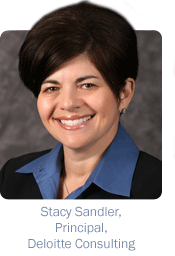
 Deloitte Consulting's Principal Stacy Sandler's focus is assisting providers of retirement with their business issues and opening new avenues through which to differentiate their business offering. Deloitte's recently completed annual benchmarking survey examines the climate of 401(k) plans, and how economic pressures like rising healthcare costs, high personal debt and low savings are painting a less-than-rosy picture of the state of retirement readiness for millions of Americans. Sandler shared some of her insight on the results of the survey and more.
Consulting: Of the data points revealed about the state of the 401(k) world in Deloitte's benchmarking survey, which do you think is the most significant or telling in terms of the economic era we're in?
Sandler: The most significant data point is that only 15 percent of plan sponsors believe most employees will be financially prepared for retirement. The reason that this is significant is that it is relatively unchanged over the course of more than ten years that we've performed this survey. The picture is not improving, and we continue to see life expectancies increase, added uncertainty over the future of social security and the seemingly continuous rise of the cost of healthcare. In addition, when asked to rank the No. 1 top improvement that record keepers can help plan sponsors with—"Improve participant readiness for retirement"—this also validates the concern for employee financial preparedness—and the assistance that Plan Sponsors are longing for to help their employee population.
Consulting: At a time like this when we're sort of teetering toward full-on economic recovery but it's going perhaps slower than we'd like, is this a time for plan participants to double down and keep funding their 401(k)s, or is this a time to rein it in and use that money for household expenses, etc.?
Sandler: This is a very difficult question because it varies from one individual to the next. Some would argue that we're not close to 'full-on economic recovery' given the situation that we're watching unfold with the Eurozone and broad economic slowdowns in many other parts of the world. Many are still unemployed or underemployed and others have unfortunately needed to access their 401(k) accounts in lean times. Certainly the idea is to buy in when prices are low, and some participants are doing just that. Others are still feeling snake bit over the recession and aren't ready to jump back in just yet. That said, given that 401 plans are meant to be a long term savings plan, continuing to fund would be beneficial.
Consulting: The numbers shown in the benchmarking survey show the majority of plan participants are between 41 to 50 years old, why aren't more young people participating in their companies' 401(k) plans?
Sandler: While we didn't specifically survey plan participants, it's generally accepted that the majority of young people who don't participate in their 401(k) plans just feel that retirement is too far off to be concerned. Others lack the education necessary to understand and get involved with their 401(k).When we asked plan sponsors what the primary barriers were to improving overall plan effectiveness, the top choice was lack of employee understanding with the second choice being ineffective employee communications.
Consulting: What are some trends emerging in terms of employers enticing their employees to participate? Are matching contributions on the rise/fall?
Sandler: Matching contributions have been on the rise, but this is often due to changes in the defined benefit program (i.e., reducing/freezing pension benefits while improving defined contribution benefits). Our survey this year noted among employers considering a change to employer contributions in the next year 56 percent are considering increasing their match. Many employers are adding other features to their 401(k) plans in an effort to provide additional tools for the plan participants. These may include investment advice, managed accounts, self-directed brokerage windows and Roth 401(k) contributions. What we find though is that too often these features are under used, often with less than 10 percent of participants using the new features.
Consulting: What are some pitfalls to avoid when managing your own account?
Sandler: Too often we see participants react out of fear or emotion when they see a dip in the market. The impulse is to transfer balances out of equities and into stable value options. When the market picks back up, the instinct is to transfer back into equities in search for higher returns. The result is a "buy high / sell low" approach which is exactly the opposite of what we should aim for as savers. Participants should invest for the long term and regularly review and rebalance their investments accordingly. They should also take advantage of the various education and advice tools that are available from the plan.
© Arc, All Rights Reserved. Request academic re-use from www.copyright.com. All other uses, submit a request to TMSalesOperations@arc-network.com. For more information visit Asset & Logo Licensing.