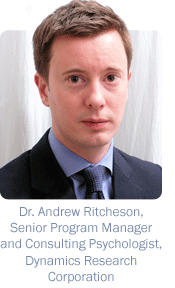
 Dynamics Research Corporation's healthcare practice has long been at the forefront of providing clinical expertise and IT solutions to ensure our nation's service members receive the best possible medical care. Over the last two years, a new approach, known as 'clinical consulting', has emerged, which seeks practitioners who combine the medical expertise of a physician with the problem solving skills of a consultant. Dr. Andrew Ritcheson, Senior Program Manager and Consulting Psychologist of DRC's Federal Group, has pioneered this new frontier, and it's already paying dividends—leading to a growth rate of more than 100 percent in the practice over the last two years. Not bad at a time when many companies are still recovering from the throes of the Great Recession. Ritcheson sat down recently with Consulting One on One to discuss the firm's growth and the overall state of the healthcare market.
Consulting: What is 'clinical consulting' and how does it serve the client?
Ritcheson: The original precept was this: a [subject matter expert] is pretty good, but a SME who can consult is even better. SMEs are good at developing focused requirements; they come in often times for very specific problems and will remain or move on to a different engagement. When I first began considering this idea, it seemed to me that if you can have a professional of that caliber who was also able to remain in place to implement the changes or solutions or interventions that their original insight provided, that would be even better. For example, if you brought in a psychiatrist into an engagement that was about developing new models of care, or providing different kind of treatment for returning service members with traumatic brain injuries, it's fine to have them able to say, this is the standard of care, this is the clinical practice you should utilize, but if they're also able to address broader concerns, that's going to be even better.
Consulting: What do you attribute the practice's extraordinary growth to in these uncertain economic times?
Ritcheson: I think it's in large part because we're able to offer fairly safe, responsible and mature stewardship of their organizations, and a very successful track record in addressing their challenges. Clinical consultants offer a higher value capability to the client because they are not only providing their own insight and professional expertise, but they're also on the ground implementing solutions. So in many respects there's a two-for-one element. You're getting people with PhDs, and MDs who are also very effective change leaders and trusted advisors to their clients. I think, for example, in the health IT area and electronic health records. That sounds as if it's principally an information management IT concern, but it's not. Our clinical consultants fit in between the IMIT folks and the clinical personnel using this new system, and are able to act as a kind of bridge between the two parties.
This [Interoperable Electronic Health Record] is a major initiative that will be rolling out over the next several years, and this is a place in which clinical consultants can provide particular value. A lot of the growth is due to the changing geopolitical situation: the drawdown in troops means a large number of individuals returning with an array of complicated injuries and psychological disorders. This is a real challenge to our system and our models of care, it also represents a financial challenge. It's something that is in a large part unprecedented in the clinical world. I think we've been particularly good in this space because of our ability to muster clinical consultants to meet these challenges.
Consulting: How do the various skill sets required of clinical consultants all come together on engagements?
Ritcheson: On engagements, our consultants bring with them not only their core clinical skill set, but also those consulting skill sets they've developed over time. Some are experts at leading change and employing Lean Six Sigma, which is critical as we are called to do more with less, to be lean and to be efficient. On the IMIT side, we have clinical consultants who have served before, they're very familiar with the various platforms that are used as EHR, their benefits and limitations … and have had ample time to consider how it might be improved.
Consulting: What does the future hold for clinical consulting?
Ritcheson: As I see it here at DRC, the future is very bright indeed. My personal concern as time goes by is to develop a regular way of recruiting and developing candidates who may become expert clinical consultants. In my experience, it has not been something to which all clinicians are naturally inclined. Some clinicians like to be clinicians, and that's just fine. Some consultants want to be just consultants, and that is also just fine. It's the identification of people who might fill that space in between that I'm turning my attention increasingly towards. There is no psychometric screening tool that lets me know the person I'm speaking with is going to be a wonderful clinical consultant, but we are developing ways. I believe that with time, this will become a very common part of our shared consulting parlance, and I think we're well on our way in that regard.
© Arc, All Rights Reserved. Request academic re-use from www.copyright.com. All other uses, submit a request to TMSalesOperations@arc-network.com. For more information visit Asset & Logo Licensing.