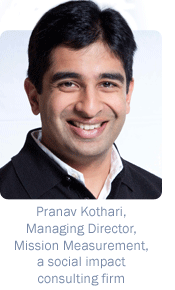
 One effect of the economic downturn has been a significant slowdown in the flow of public and private charitable dollars. Over the last few years, as the economy has slowly crawled its way back from the brink, for-profit corporations and non-profit foundations alike have sought ways to ensure their philanthropic efforts are having the impact they intend, and are getting the most bang for their buck in a time of scarce resources. Pranav Kothari, Managing Director of social impact consulting firm, Mission Measurement, says the firm looks to help clients quantify the outcomes of their philanthropy work, and help shape new strategies to help them improve their existing efforts. Consulting One on One recently sat down with Kothari.
Consulting: What is a social impact consulting firm?
Kothari: Our mission is to measure and improve the social impact of our clients. All the work we do starts with the idea that our clients are trying to drive at some meaningful social impact in a variety of areas. Our role as a firm is to help them measure what they're currently doing, but also develop strategies and approaches that can improve what social impact they're actually trying to have. We have clients that are non-profit organizations, charitable foundations, corporations and government agencies. One defining commonality among our all our clients is they're uniquely and sincerely trying to derive some social impact.
Consulting: How do you quantify the impact a company's philanthropy efforts are having?
Kothari: The core of our work is what we call 'outcomes measurement.' We help organizations define a set of outcomes they're trying to accomplish and build measures, via research, via past experiences, versus sometimes creating new measures to mark progress against those outcomes. A lot of this is a really interesting combination of social science, statistics, evaluation methods, as well as strategy consulting, that allows us to develop new ways to measure things that folks have not been able to measure in the past. For example, we've developed approaches to measure changes in public will and policy change, so organizations who are managing against that outcome actually know whether they're making a difference.
Consulting: How is Mission Measurement different than more traditional consulting firms?
Kothari: One of biggest differences we hear from our clients is that we are very co-creative and collaborative in the work we do. Our consulting work is always with our clients, we're not doing something to our clients. The approach we take is really about long term goals. Everything we do with a client is done in a capacity-building way so they're in a position to not only learn from our expertise, but also to drive that change within their organization. Our goal is to always be involved in that improvement piece. The measurement is not the end—in a lot of ways it's the beginning—because we can go through that evaluation cycle adapt the strategies to increase the impact in a meaningful way. That's definitely a big part of our work and has always been, in a lot of ways, the most meaningful work we do.
Consulting: What was the catalyst that paved the way for Mission Measurement?
Kothari: I think there were a few needs that were sort of the foundation of this type of consulting work. First, a lot of nonprofits and government agencies started getting much more interested in program effectiveness. If I'm a large social service agency and I've got a ton of programs that are running, some privately funded some publicly funded, how do I know which ones are really achieving meaningful results, especially in a world of scarce resources? That was a big basis for the work there. Another piece, I think, stemmed from newer money that came into philanthropy in the early 2000s from Silicon Valley as owners were selling off their companies and had money available to support meaningful endeavors. I think the expectation among a lot of them was: "Why isn't there more data available in this sector?" Foundations like Gates Foundation and others really pushed the sector to demand much clearer information about what outcomes and impacts we are achieving.
© Arc, All Rights Reserved. Request academic re-use from www.copyright.com. All other uses, submit a request to TMSalesOperations@arc-network.com. For more information visit Asset & Logo Licensing.