By Denise Martin
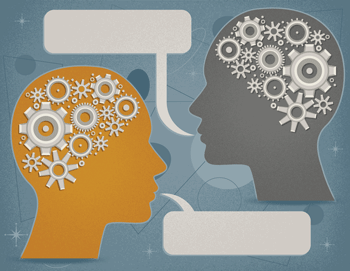 How easy is it to talk to someone and really think that your message got through? How do you know for sure? If they didn't look at you quizzically, how do you know that they simply didn't want to ask you to repeat, for fear of appearing unintelligent? Or maybe they nodded their head, which led you to believe there was full understanding behind that nod, but really their understanding was different from what you believed you were expressing.
If this has ever happened to you, or perhaps happens to you frequently, or happens and you don't know that it's happening to you, then you are like so many others in the harried business world with poor communication, miscommunication and missed communication.
Communication disconnect is rampant, but you can take a few simple steps to change your habits and communicate better. Strong communication and rapport skills are important for every job, in every field, in every industry. Those who communicate well rise to the top higher and faster than those who may actually be more skillful in their mastery of technical abilities, but lack the 'soft' skills of communicating well.
So, Coach, what am I lacking? Where do I begin? Start first by listening, really listening to the specific language they are using, then speak to them in return in that same language—and this is not referring to speaking English here. We all operate within a sensory language, and we have a preferred style for learning, for processing information, for communicating.
While we use all of our senses, we tend to prefer one over the others. We may not even recognize we have this tendency; so we certainly don't think that others may have a different preference than our own.
Those who have a visual preference are easily recognizable by their language. They will say such things as: "I see what you mean", "I get the picture", "it's just not clear to me", "please clarify", "let me look into it", "here's where we need to focus", "in light of this news…" Visuals are also recognizable by their fast speech patterns (they think in pictures), well assembled appearance, attention to visual details.
Those with an auditory preference have language patterns like: "I hear you loud and clear", "that resonates with me", "doesn't ring a bell", "let's talk it over later", "that sounds about right", "let me explain", "listen… "
And the kinesthetics of the world process through feelings. They talk slower because they are thinking in emotions, which take a while to build. They use expressions such as: "that feels about right", "I'll be in touch", "let me come to grips with it", "hold on a second", "get a load of this", "I need to get a handle on it", "I'm just not comfortable with this".
You've probably heard all these expressions several times and have never given any thought to them. Once you recognize that there's a pattern to a person's language and that they are expressing a preference in how they like to communicate, it is obvious that if you communicate back in the same mode you will be on the same wavelength. If you stay on your wavelength and do not switch to theirs the communication is simply not as clear.
This takes practice to listen carefully and to switch your language to their sensory language while saying the same thing. If a visual says: "It's rather vague to me right now" and your natural inclination is to say, "Allow me to explain", a stronger response would be, "Allow me to clarify it for you". Are you getting how this works? It's quite powerful in furthering communication between people because it's always about WIIFM—and what's in it for the other person is maintaining their own preference. They will simply hear you better when you speak in their sensory language.
Another avenue of communicating strongly with language is in the specific words we select to use. Words are very powerful because they structure our thinking and can change our brain patterns simply by speaking one word versus another word choice. Why is this, you wonder? It is because words often carry a subliminal message that triggers automatic emotions. Our brains create pictures to digest information from the spoken word. If it cannot be pictured, the brain often skips over the word it cannot picture. The use of the word 'don't' is a good example, and should be used with this knowledge in mind.
If I say, "Don't picture a bright red sports car" you have no choice but to picture what I suggested that you not do. The brain jumps right over the word 'don't' that cannot be pictured and moves right for what can be pictured. Now knowing this pattern, what do you think happens when you say, "Don't worry about a thing"? "Don't give it another thought"? You can also use this to your advantage: "Don't rush, take your time"! Ever wonder why disciplining children can be so hard? ("Don't touch that!", "Don't run away when I'm talking to you!" "Don't (etc)… !")
There are many words to avoid using. I'll touch on a few of the most important ones. 'Try' is a death knell—it's code in the brain for "it's okay to fail". If you use it yourself and it's important, you are really telling yourself that it's not that important. And when you hear others use it, they're probably not going to be coming through. Remember the wisdom of Yoda, "Do or do not. There is no try."
'Want' should be eliminated and replaced by 'need' almost every time. 'Want' is a childish lament that shows basic selfishness – it's all about you, is it? 'Need' comes from a more visceral place – recall Maslow's hierarchy. "I want you to consider …", "I want another chance", "I only want what's best for you" – now replacing 'want' with 'need' makes all these statements more powerful.
'Should' is a scold, which nobody likes hearing. Stop using it in your own self-talk ("I should exercise more", "I should eat better") and stop scolding others. Shoulds are not motivating and result in incongruent behavior, as we rebel against being told what to do, as if we were still children. The automatic response to "you should" is "I don't want to", even when we really do want to. 'Should' is about pleasing others; 'want' here is about avoiding unpleasantness, which is in opposition to each other, hence the incongruity. The replacement word for 'should' is also 'need'.
'But' signals a disapproval is coming next, and the defensive thinking begins. When defensiveness kicks in, critical thinking replaces active listening and communication decreases. The mind just can't pay strong attention when it's busy thinking about all the possibilities that 'but' is triggering. How much better it would be to simply change every 'but' to 'and'—it's so easy to do!
The list is long, but a flavor of some words to use are: 'we', 'our' and 'us' are great rapport building words, versus distancing words like 'you', 'they' and 'your', or exclusionary words like 'I', 'me ' and 'my'. 'Perhaps' is an excellent word to include often in your vocabulary, as it softens a refusal or a request. 'Might you…?' also softens and removes pressure versus 'would you…?' 'Because' is the most persuasive word in the English language, because our brain is conditioned to believe that a good reason is coming after it.
When the brain goes into automatic mode, it stops conscious thought and compliance with the request is the result. Using 'because' with every request makes you very persuasive. And remember the power of 'please' and 'thank you', the most powerful words you can use, right behind the person's name.
A discussion about the power of language would not be complete without the mention of the way we talk to ourselves when describing important goals we want to achieve. These must be stated in the positive, as when they are framed in the negative, as is often the case, self-defeating behavior is the result. Is your goal: to go on a diet (limit your food intake)? It is better worded: to weigh X pounds (your desired weight). Is your goal: to stop procrastinating? How about changing it to: complete a specific project. Is another goal: to exercise more? A more worthy goal is: to have a fit body. Once the self-talk is correctly worded, the brain goes to work to make the picture into reality.
Language is very powerful in communicating—with ourselves and with others. Language can change our memories (that accident—did the other car 'smash' yours? Or did the other car 'hit' yours?), diminish pain (did you receive a 'small cut'? Or was it a 'large gash'?) and elicit excitement. Knowing the power of the spoken word and using it effectively is a most effective tool in having great communication skills.
Denise Martin is President of Good For You Coaching & Consulting, Inc., a firm that provides clients with superior sales and communication coaching and training, resulting in greater prosperity in their own businesses. The author can be reached at denise@goodforyoucoaching.com.
© Arc, All Rights Reserved. Request academic re-use from www.copyright.com. All other uses, submit a request to TMSalesOperations@arc-network.com. For more information visit Asset & Logo Licensing.