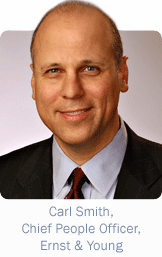
 How would a consultant look at talent management? That was the question Carl Smith was faced with a few years back when his role at Ernst & Young shifted from serving clients to serving consultants as Americas Advisory People Leader. Since that time, Smith has completely transformed talent management at Ernst & Young—everything from recruiting and onboarding to the development and retention of more than 7,000 professionals. One major new initiative includes how the firm has revitalized its resource management by rolling it under its people function as "experience management." Smith will expand on the programs he's put in place and how they've moved the needle at E&Y in his "Transforming Talent: Engaging, Retaining, and Developing People at Ernst & Young" presentation at the Consulting Summit on Nov. 9 at the Union League Club in New York. Smith sat down with Consulting One-on-One to discuss the progress he's made in his current role.
Consulting: What were some of the biggest changes you implemented when you became Americas Advisory People Leader at Ernst & Young?
Smith: There were a few areas we really focused on initially. I was a consultant by trade so there was, of course, a big focus on program management. Everything we did around strategic initiative was managed like a project with all the deliverables, milestones and rigor that we would put into serving out clients. From the beginning, we had a very strategic focus; we doubled down on focus. We were very deliberate in how we approached the people function and I think that was certainly a change from the past. Also, I was adamant with my team that whatever you touch had to be sustainable. I want to be constantly building the house, layering on top of layering. This creates a mindset of continuous improvement. You're never done.
Consulting: Were there any other new initiatives?
Smith: Yes, and they are huge. We conveyed to our People team that they are business partners. They get a seat at the table. This was a game-changer. So, when executives were talking about a strategic plan or how many people we needed to hire to execute it, the recruiter had to be in the room, the person doing staffing had to be in the room. In meetings, these people were showcased, not me. That created a different dynamic where they were viewed as business partners within the company. However, this also meant that the People team had to understand the entire business, they had to become students of the consulting profession. We also had a huge mind shift in the People team at this point, and it went like this: Treat Ernst & Young like a client and not your employer. That mentality changed a lot for the entire team. When you think that way, you think clearer and every decision becomes easier to make.
Consulting: How did you make that shift internally?
Smith: Well, for one, we are the only firm that I know of where the experience manager reports into the people function. Usually, experience managers report into the COO because it's all about utilization. My commitment to the board was that not only will we maintain utilization and get the right resource to the right place at the right time, we're going to show you how to link development, deployment and inclusiveness. And we have done that. It's been a lot of hard work and it's paying off.
We also went to an "e-room" approach. We moved to a more transparent model where we post all of our pursuits, all of our delivery engagements and all of our strategic initiatives in the e-room so that all of our people could see everything we're doing. It's a little scary because you're opening the books, but it allows more transparent awareness of what we're doing and people could lobby to get staffed on certain engagements. It's innovative and has worked out wonderfully.
Consulting: Just to be clear, when you say "experience manager," are you referring to what's traditionally known as a resource manager at most firms?
Smith: Absolutely. I hate the term "resource manager," people are not resources. We changed the title to "experience manager" and that's not just to be hokey. We did it because we honestly believe the function is to get our people the right experience. That's the magic. We also train the experience managers because we really wanted to break up the tendency to staff the same people on the same engagements. That's a natural consultant's tendency. You get these groups of people and you go from engagement to engagement. You do gain some economies of scale when you go about it that way, but you do not inject a lot of diversity, a lot of ongoing experiential learning. Some 70 percent of learning comes from experiences. We've doubled down on the experience function. We've been able to deliver more diverse teams on our engagements, and that serves our clients a lot better.
Consulting: How do you know all the changes you've implemented are working?
Smith: We know it's working because we just recently received the results of our Global People Survey. We went up multiple percentage points on 50 of the 74 questions. On about 20, we remained neutral. The most notable gains were in strategy and leadership, people development, and recognition and rewards. Also, our engagement index went up four percentage points. That's an extraordinary number and confirms that there is something special going on.
Consulting: Besides the obvious advantages for clients, what do these successes do for your recruiting and retention?
Smith: Two years back, voluntary attrition was at about 20 percent. Right now, we're running at about 16 percent. And we're bringing great people into the firm all the time. It is a ferociously competitive market for talent, and we've hired 4,000 people into Americas Advisory in the last two years. That's a lot of people that we have to assimilate and onboard very effectively. We have to hold onto our talent. We can not be a revolving door.
For additional information on the Consulting Summit, Carl Smith's presentation or to register for the event, please visit www.ConsultingSummit.com.
© Arc, All Rights Reserved. Request academic re-use from www.copyright.com. All other uses, submit a request to TMSalesOperations@arc-network.com. For more information visit Asset & Logo Licensing.