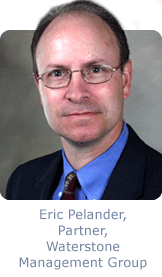
 When a bunch of consultants get together to form their own firm, the elevator pitch usually touts their collective experience. But few firms can match the brainpower of Waterstone Management Group, whose leadership includes: Chairman Roger Nelson, the retired Deputy Chairman of Ernst & Young, who led the growth of the US practice from $300 million in revenue to $2.5 billion, and the eventual $11 billion sale to what is now Capgemini; Waterstone co-founder Mark Hauser, former CEO of Cap Gemini Ernst & Young Americas; and partner Eric Pelander, IBM's former global leader of strategy and change services and a key member of the small senior team that was responsible for the acquisition of PricewaterhouseCoopers' consulting practice. (And yes, he's a former E&Y partner, too.) So, when Waterstone's leaders say they're finding new success with their firm, we listen. To find out more, Consulting's One on One recently sat down with Pelander to see what's keeping his team busy.
Consulting: What trends are you seeing in the marketplace?
Pelander: What we see is a real interest from our clients in strategy with a bias toward quick action. We do the proper strategy work: we identify how big the potential opportunity is and try to determine if the opportunity is viable for the client, etc. But our clients want us to very quickly get to execution. We're able to access issues faster than most firms because our senior people have all operated businesses or pieces of large businesses in addition to consulting.
Consulting: How does this 'bias toward quick action' compare to what clients were asking for a few years ago?
Pelander: Five years ago there was a greater willingness to more thoroughly study what the strategy should be. This is a gross generalization, but a typical client would have said, 'we want you to do a strategy project for us for four to five months, be thorough and vet all opportunities and then move into implementation.' Now, it's not uncommon for clients to ask us to move through the strategy issues in eight weeks and then do trials and experiments toward implementation. They'll often ask us to continue to do some more strategy work while we're working on implementation. The attitude has shifted to: 'If we can do implementation without betting the farm, let's do that.' And it's only possible to move that aggressively with a team that possesses deep experience and expertise.
Consulting: We've been hearing that clients are still very cautious and risk adverse. Does this 'bias toward quick action' signal a change in attitude?
Pelander: I think it may speak to the different ways clients are looking at risk. On one hand, there's the natural inclination to study something to death and therefore not make any mistakes. But there's risk in moving too slowly or not moving at all. Clients don't want to take a large amount of their time, executive's attention, and financial resources and then not have done anything. We understand that approach. I ran a piece of IBM Global Services that employed 3,000 people and generated about $1 billion in revenue. We've got a pretty visceral feel for what it takes to get to the stop/go decision. And our teams are comprised of more senior talent than most firms. At a strategy firm, the average staff to partner ratio on a project is about 8:1; we're usually 3 to 4:1. Clients are getting much more focus from our partners than they would from another firm that has to keep twice as many junior consultants busy.
Consulting: Does your top-heavy model also require a different pricing and fee model than more traditional firms?
Pelander: After the initial strategy project, clients will typically pay us a retainer for the execution piece. And we will often have a success piece tied to our compensation. Our success fee approach is also unique. When most firms negotiate a success fee, the firm and the client tend to try to be very specific about what aspect of a project the consulting firm is working on and has control over. Our experience is that sometimes those arraignments work, but it usually requires a long debate over how much the success fee should be, how to determine whether the consultants or the client's people have responsibility over this or that. We approach success fees differently. Our client sponsors are at the highest level—usually the CEO or head of the business unit we're working with. And we throw our success fee into the same pot they're betting their bonus on. We want to help the executive team across a series of issues and if in the middle of working on one thing we see that there's a bigger need for us elsewhere, we don't want there to be a disincentive for us or management to identify and then tackle that challenge first.
Consulting: Is your new model proving successful?
Pelander: We will grow this year by about 40 percent and, in the last year, we've picked up three clients that generate greater than $20 billion in revenue. We have, by choice, wanted to grow aggressively, but in a contained manor. We don't want to change the model we just talked about. We don't want to grow by adding scores of junior people.
© Arc, All Rights Reserved. Request academic re-use from www.copyright.com. All other uses, submit a request to TMSalesOperations@arc-network.com. For more information visit Asset & Logo Licensing.