By Denise Martin
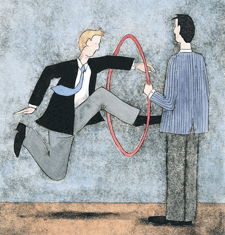 I still remember Sally Field, while she held her "Coal Miner's Daughter" Best Actress Oscar aloft, gushing to the audience "You LIKE me!! You really LIKE me!!" Why is it so important for us to be liked? And make no mistake—it is important to be liked—very important in business. We are hardwired as social creatures to want to be liked.
After all, the very continuation of the species depends on us being social with each other. We consider the loner, the misfit, and the socially inept as pariahs and avoid them where possible. We simply prefer to say 'yes' to people that we like. For proof positive, look at the success of Tupperware parties, office charity requests for their kids' activities, attendance at benefit auctions, etc.
Now some may argue, "I would rather be respected than liked," but deep down they know that's not really true. They hold envy for the socially gifted in the office and real jealousy if those gifts are coupled with actual capability. How unfair is it that talents aren't equally distributed!
Certainly we respect people for their intelligence, their hard work ethic, their competence. But when push comes to shove, we unconsciously, and most certainly, give the business to the person we like better, and all things don't even have to be equal.
We decide this in our amygdala, the seat of our emotions in our brain. Then after the decision is made we backfill with logic, as the brain's logic center, the neo-cortex takes over. Not only would we never admit this, most of the time we don't even know that it's happening.
Our beautiful brain works on autopilot most of the time, saving us from having to think too hard. The brain's job is to insure our very survival, not just physical but all aspects, including emotional survival. Once we recognize that people are hardwired to be liked, who do we like? How do we decide? We like those that are like us!
Why? Because it reinforces to us our own importance, our own goodness, our own validity for being here. We all have mirror neurons that reflect back in our own bodies what we see. If we see someone like us, we mirror back our own comfortable self and we can't help but like the person. The brief experience unconsciously reminds us of our childhood and those sweet emotions, as our parents reflected themselves back to us.
That trusting environment is embodied in the emotion of liking someone. It is critical in the art of doing business. You will never, repeat never, do business with someone you don't trust. Also true is a corollary fact: you will never trust someone that you don't like.
So how do we become likable?
The easy start is to smile—developing a social smile habit benefits everyone. We smile when we see something we like. When you smile at someone his mirror neurons can't help but smile back. His brain thinks that you saw something likable—him!—which makes him feel good. Endorphins are released and then he actually does feel good. He likes you in return, and all you did was smile. Even if it's only a habit that you developed, everyone benefits. Caution: Don't go walking around with a stupid smile pasted on your face all the time; develop the habit of flashing a social smile when you make eye contact with another. Side benefit—you'll feel happier too!
Since we like people who are like us, find out the COMMONALITIES you have with the other person.
This is really common sense, since we intuitively know to lay a basic foundation to build from (notice how the first comment with the stranger is usually about the weather, establishing that we all live under the same sky), but I can't stress enough how important it is to have that small talk before launching in with your business dealings. A recent study concluded that negotiations that began with 10 minutes beforehand for the parties to get acquainted were successful 67 percent of the time; without those 10 minutes they were only successful only12.5 percent of the time.
The purpose of this brief window of time is to establish common ground, likability, trust—useful later to break a stalemate and create a win-win. Don't waste it—find something, preferable personal, which you can point to for sameness. And the key to finding those commonalities is to ask open-ended questions and really listen. Active listening is the greatest compliment you can pay someone—you are really important and you have 100 percent of my attention. Don't be thinking ahead of your next response or start going on about you. Keep the conversation on her and point out whatever you discover in common, even if it's just opinions that you share. This is easily done with an agreeable nod, a head tilt, a pleasant smile and steady eye contact. A full 10 seconds (hold it… hold it…) establishes great rapport.
COMPLIMENT him – "Nice tie!"
His read: I have good taste in clothing which you obviously recognize so now I like you, since you have pointed out that we have our good taste in common. We humans are also hardwired to enjoy hearing praise and like the flatterer, even when it is obviously false. Think of an applause sign flashing, people clapping, the entertainers grateful. The canned laugh track on the TV comedy works much the same way. We laugh right along with the fake laughter—oh those mirror neurons! "Great minds think alike"—this works on three levels: establishing commonality, complimentary flattery, self-praise (any label, even self-bestowed, is credible).
Cooperation has a heavy influence on likability.
Use "we" language to establish closeness, camaraderie, a team feeling. Teams have the same goals, make the same efforts, rally for the same causes, and cooperation among teammates is essential to group success. Teammates are allies who we trust implicitly (at least initially, if there is no cause not to). Jump right in with the "we this…" and "we that…" which sets the tone for automatic inclusion in the inner circle. Again our brain, which is always looking for shortcuts in processing the vast amount of data that it is bombarded with continually, takes the "we" at face value and moves on. You're in, just that easily!
We like what is FAMILIAR.
If you have any link to his past and can somehow throw in a "we go way back" by all means use it: by establishing, then playing up on that link, it bonds you to that person better than if you don't bother to mention it. Don't be afraid if the link is weak, or if you think it's too minor to mention, let alone play up; do it anyway, with a light tone, especially to a third-party.
"Joe here and I, we go way back—we both grew up in the Northeast!" Pretty weak connection, you think, if there is even a connection at all; but the "lazy" brain looking for the data shortcut accepts the rhetoric as truth, without questioning the logic. And Joe, who suddenly appears to be from your hometown
(or nearby) now likes you for certain, due to that (contrived?) commonality. Of course, if you truly are familiar to the person (as in, you have called and left your name and message several times) you will be a degree more likable in person over a complete stranger, due to the familiarity tenet.
Be sure to SAY HER NAME often, in natural conversation, her favorite word.
However, be conscious not to repeat her name to the point of obvious manipulation, as some overbearing salespeople have been known to do, which is just obnoxious. Side benefit: If your name happens to even start the first initial as his name—bonus! That small, almost obscure and certainly random fact resonates subconsciously as another point in common, making you even more likable.
And finally, if you can get him to DO YOU A FAVOR, even a small favor, be sure to ask.
"Would you mind terribly if I asked you to…" We subconsciously believe that we only do favors for those we like, so if we do a favor for someone, in our mind we must like them, or we never would have agreed! Once the likability is established subconsciously,
we tend to live up to our set expectations. We hate to be wrong.
Your business dealings are important. Don't overlook the importance of the likability and trust factor in those dealings. Just some awareness and then some preparation can make a huge difference in ultimate success. You're good at what you do; you know your stuff—give yourself the additional advantage in all your interactions by taking some steps to practically ensure your likability and feeling of trustworthiness.
Denise Martin, is president of Good For You Coaching and Consulting, Inc., a firm that uises the science of human behavior patterns, the basic tenets of body language principles, and the constructs of business to help clients gain superior negotiation, selling and rapport-building skills. The author can be reached at denise@goodforyoucoaching.com.
© Arc, All Rights Reserved. Request academic re-use from www.copyright.com. All other uses, submit a request to TMSalesOperations@arc-network.com. For more information visit Asset & Logo Licensing.