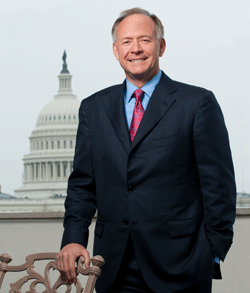
 Excellence in Public Sector
Joe Davis
Americas Leader, Public Sector practice
The Boston Consulting Group
In what must seem like another lifetime—long before he moved to Washington, D.C. in 1995, a move that would eventually lead to becoming the Americas Leader of the Public Sector Practice at the Boston Consulting Group, and before he joined BCG's Boston office in 1988—Senior Partner Joe Davis was a sales representative at Procter & Gamble. "I began my career selling shampoo," Davis says. "I've always had that mind set; I've always been more an action guy, not a let's-sit-around-and-wait-to-see-what-happens type of guy."
It's probably no surprise, then, that Davis essentially volunteered to launch and build BCG's federal practice from nothing back in April of 2009—literally from the ground up. And while a sales rep is certainly not the pedigree of most BCG practice leaders, Davis says he sees himself as just a businessman building a business.
"People often tell me that I'm really just a businessman in consultant's clothes," he says. "I take that as a compliment, and the P&G experience, I think, probably taught me how to build a practice from scratch. It's not just about having the next great idea, it's about how we are going to build a business. Who are the clients that have interests in what we bring to bear? P&G prided itself on that."
And now, so does BCG's Public Sector practice. "For me, this was always about building a business. The reason I wanted to do this two years ago was because it was an opportunity to do something different, and I've always liked a challenge," Davis says. "Consulting is such a great job because you are constantly getting stretched every day. I figured, if it works, great. And if it doesn't, well, then I'd learn from that, too. But, honestly, I can tell you that I never intended for this not to work."
As sure as Davis was, there was some healthy skepticism initially within BCG, he says. While the leadership team thought BCG should absolutely go for it, others in the organization weren't so sure. (One of the reasons BCG opened its D.C. office in Bethesda, Md. and not Washington D.C. back in 1995, incidentally, was because BCG was not there for federal work.)
The traditional nature of government work, procurement, the public nature of the engagements and the opportunity costs associated with taking Davis off his retail client work were all perceived as negatives, he says. All of that, I think, was ultimately proven wrong." Davis says. "If you're working with the federal government on the biggest issues of the day, that is no different than the private sector work we do so well," Davis says. "I knew what type of work we'd be doing—the work we do best. That was the idea."
Davis was well aware of the newfound energy between the federal government and the business world and thought BCG had a lot to offer federal clients with its commercial best practices. Plus, the practice would have two additional benefits—attracting top-notch talent to the firm and providing more local work for the Washington D.C. office, which Davis manages. "Both turned out to be absolutely true."
"We Know A Lot Of People"
So, how exactly does one build a business from the ground up, in a brand new market? "The first thing we did," says Davis, "is we got out and met as many people as we possibly could. Who do we know? I mean, we're BCG; we know a lot of people."
For months, Davis set up meetings with anyone that would take his call. "It was 'Here we are; here's what we do, and here's what we think are the big issues on your mind," Davis says. "We just wanted to get on people's radar screens. It was meet, meet, meet."
In other words, it was typical Joe Davis style. "You can talk and analyze forever, and I wanted us to act," he says. "I can guarantee one thing—if you're not out meeting with people, there is no way you're going to end up on an RFP list."
Davis' first big break came just two months after launching the practice when BCG was the lone management consulting firm tapped by the U.S. Treasury Department to advise President Obama's auto task force relating to the Chapter 11 reorganization of General Motors and Chrysler. "That was rapid fire—like ten weeks, 16 hours a day, six-and-a-half days a week, but nobody complained," Davis says. "That really got the practice off and flying." The Treasury hired BCG again last year to advise on GM's $20 billion-plus IPO—the largest ever.
Shortly thereafter, the firm was selected to advise the U.S. Postal Service on a wide-ranging potential transformation. In a report titled "Projecting U.S. Mail Volumes to 2020," BCG projected a 15 percent decline from 2009 and a 30 percent drop from a high-water mark of 213 billion pieces in 2006. "That was quite controversial."
Most recently, BCG was selected to conduct independent studies of the operations of the Securities and Exchange Commission and the Federal Deposit Insurance Corporation. "At that point, I think people kind of looked up and said: 'OK, this is real; we're onto something here.' "
BCG has had a team at the FDIC for more than a year to help put the right programs and processes in place. "It's sort of the classic commercial meets private-sector transformation." Meanwhile, BCG had just wrapped up a deep look at how the SEC is structured and is "anxious to help them execute our recommendations."
While all of this work means a fast start publicly to the nascent practice, it's a slower go within the practice itself—from both a people and revenue perspective. BCG doesn't disclose revenue numbers, but Davis says the practice quadrupled its 2009 revenue in 2010 and should double again by the end of 2011—then double again by the end of 2013. "We've had really some good things happen," Davis says. "But the thing I'm most excited about is that we're really just getting started."
And the same can be said about the practice's dedicated resources. Initially, it was just Davis and one other principal drumming up business. Today, it's up to five full-time staffers working in Washington. "If I'm optimistic, we'll have 14 or 15 by 2014."
But Davis is also quick to point out that the Public Sector practice was never meant to function as a traditional practice. "We always knew we'd be bringing the complete capabilities of BCG to the federal market," Davis says. "From the very beginning, senior partners were very interested in coming to Washington to help—and that's the only reason this has worked."
Well, Joe Davis also had a little something to do with it.
—Joseph Kornik
© Arc, All Rights Reserved. Request academic re-use from www.copyright.com. All other uses, submit a request to TMSalesOperations@arc-network.com. For more information visit Asset & Logo Licensing.