 Many companies, including consultancies, are missing its biggest business implications
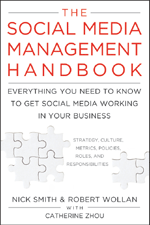
While Facebook, Twitter and other social media outlets have grown recently in popularity, few companies have really cracked the code on understanding what they can do for the bottom line. That's precisely why Accenture's Robert Wollan, Nick Smith and Catherine Zhou wrote the book The Social Media Handbook: Everything You Need to Know to get Social Media Working in Your Business . Wollan, the Global Managing Director of Accenture's Customer Relationship Management service line, says companies should remember three key things: 1) Pick a strategy before it picks you; 2) They're not on stage anymore, they're part of the crowd; and, 3) The time for
experimenting is over, it's time to jump in. He sat down recently with Consulting to discuss the current social media landscape, its opportunities and the future business potential of this rapidly evolving platform.
 Consulting: You and your colleagues have been working with clients on the implications of social media for a few years now. Why did you decide to write the book?
Wollan: The origins of the book were rooted in, like many things, our clients asking some provocative questions around social media. Through our work with them, we could identify three distinct categories of clients who had questions: One, I was just tapped on the shoulder and my CEO says we need to have an app on the iPhone. How should we get started on this and how do we do it smartly? Two, we've been sitting on the sidelines waiting to determine if social media is for real and a legitimate way to make money. And three, how do we handle this phenomenon in terms of our own employees, and, more importantly, our customers. There are plenty of very specific and narrowly targeted volumes of information in the marketplace, but we wanted to take it a step further to help companies integrate social media into the mix.
Consulting: What's the main takeaway of the book?
Wollan: Well, I think the thrust of the book is a critical, but pragmatic, look at what parts of the organization are impacted by social media, and how companies need to mobilize in order to turn the promise of social media into a business and a competitive benefit. What we tried to do is bring to life what the chief marketing officer, for instance, needs to know. What does the chief information officer need to think about when we talk about disposable technology? What does a human resources officer need to be aware of when it comes to social media policies that generally aren't in place today that can leave a company vulnerable? We attack less of the very
simple topical layer and instead look across the organization and identify what key roles should be focused on. It's a comprehensive look across the organization… that's what we were trying to achieve.
Consulting: At what point did social media take take root as viable from a business perspective?
Wollan: I think we started to see this is a meaningful way about three years ago. There were different sets of players at that point—Myspace was a little more dominant at that point and Twitter hadn't really come on the scene yet. Three years ago, I think there was enough momentum and examples of 'connected customers' that showed companies they had to get started, at least. It is now being viewed much more as a business function. They've seen enough evidence.
Consulting: In general, what are clients looking to do when it comes to social media?
Wollan: For most, I think they are looking to implement one of three strategies: First, is what I call the "Uh-Oh Strategy." Look at what happened at Dominoes Pizza when two rogue employees made a video after hours and then posted it to YouTube. Most companies don't have formalized policies in place. Second is the "It's Too Big Not To Be There Strategy." When Myspace broke 100 million users, or Facebook broke 300 million members, companies started taking notice. And third, the "Competitor Strategy," which says they are there and we need to be, too. All three of these were the early reasons people and companies jumped into social media, and they are all very reactive. Today's discussions are much more thoughtful. If you use the analogy: "Ready, Fire, Aim," many are aiming now.
Consulting: The book cites some case studies. Which companies are using social media best?
Wollan: One is Best Buy, both in terms of what it is doing to mobilize the entertainment factor that they bring to the table and the technology, such as a program that allows employees that are interested in technology to respond to customers directly on Twitter.
Consulting: Where do you see the most potential?
Wollan: To me the most interesting part of the social media phenomenon is how it is giving companies the chance to listen in on the most private conversations of customers. Companies need to realize that they're not on stage anymore broadcasting to a fixed audience; they're in the crowd and able to take advantage of it. They're able to listen in on conversations about products, services and competitors—much like the old focus groups tried to do behind two-way mirrors—except these social media customers are much more open and much more transparent. You have the real voice of the customer coming to life here, and there's a widespread acceptance that this should factor into research and development, innovation and product development. It's impacting the way companies broadcast marketing messages and that will continue to evolve.
Consulting: Where do you see this going?
Wollan: Well, there's definitely no turning back. Social media is a force to be reckoned with. The winners will be the companies that can adapt to customers needs and desires. If you look at company like Lego, it is using influencers to help define whole new sets of products. And these groups of people are passionate about the product. Meanwhile, one of the biggest untapped areas is around service. That's often where the sins of the organization show up. Anyone that looks at call centers, for instance, and looks deeper into the honest voice of the customer, realizes there are insights there that can impact the rest of the organization in a very positive way. Well, social media is the call center, times five. You can get better information more quickly. And if your customers feel encouraged, they become even more emboldened to offer their feedback whether it's positive or negative. This will move up the business model food chain very rapidly. We think 85 to 90 percent of companies will be impacted by all of this eventually. Each company will have to decide what the right strategy is and jump in, but they better pick a strategy before it picks them.
Consulting: What about within consulting firms?
Wollan: In some ways, social media a natural extension of what we do in the marketplace. And many firms probably have been using the social media concepts for some time. At Accenture, we use social media tools for internal collaboration because our employees expect it. We crowdsource. We share information and knowledge. As consultants, we have plenty to gain by embracing social media.
© Arc, All Rights Reserved. Request academic re-use from www.copyright.com. All other uses, submit a request to TMSalesOperations@arc-network.com. For more information visit Asset & Logo Licensing.